
Canadian businesses affected by U.S. tariffs may be eligible for significant federal funding to maintain operations, protect jobs and invest in new markets.
The Canada Strong Diversification Fund (CSDF) provides financial support for companies responding to trade disruption, including businesses pursuing market diversification, production improvements and capital maintenance.
Under its capital maintenance stream, eligible companies can request $5 million to $30 million in non-repayable funding to repair, replace or restore existing capital assets and sustain operations for up to two years.
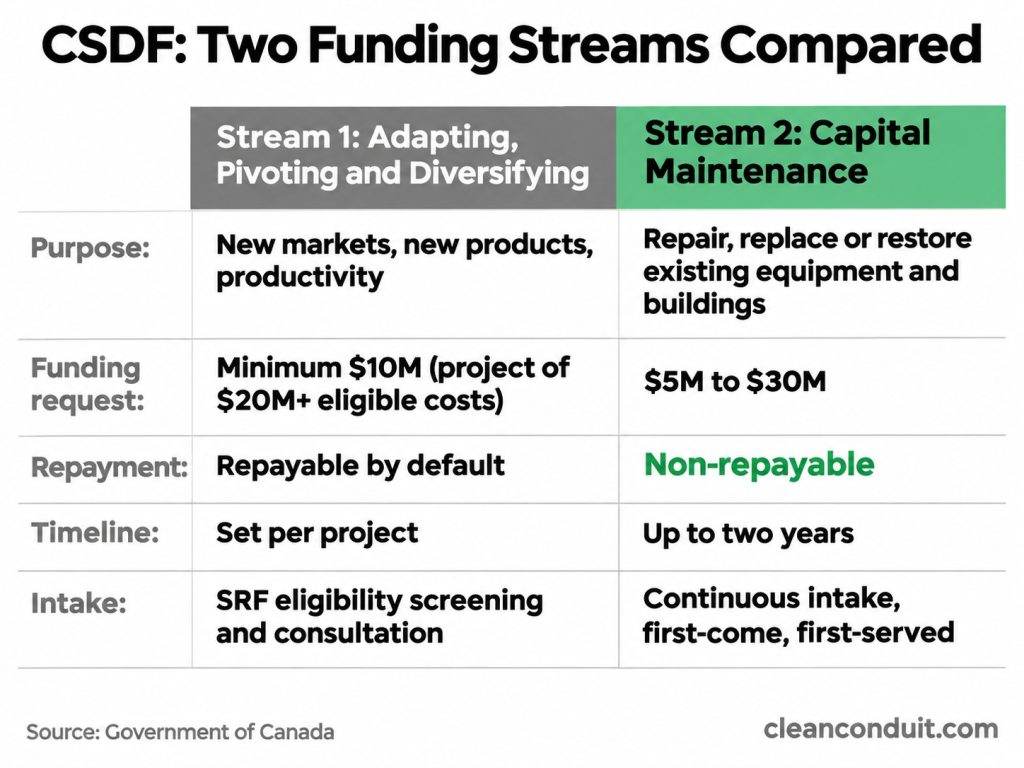
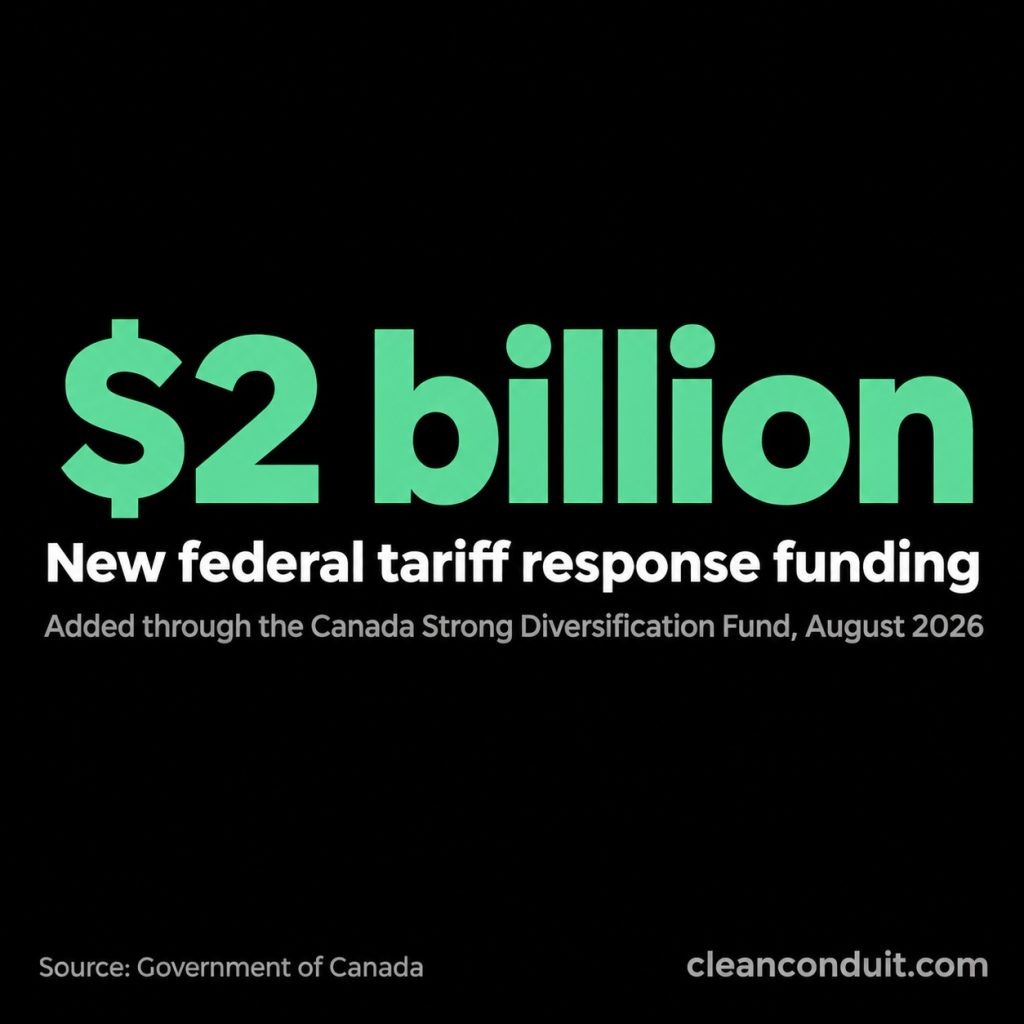
The Government of Canada announced an additional $2 billion investment through the fund in August 2026, expanding support for businesses facing new tariff pressures.
This guide explains the CSDF’s two funding streams, eligibility criteria, eligible costs, contribution terms and application process.

What Is the Canada Strong Diversification Fund?
The CSDF is a federal tariff response initiative delivered through the Strategic Response Fund (SRF), administered by Innovation, Science and Economic Development Canada (ISED).
The program supports Canadian businesses in sectors significantly affected by U.S. tariffs, particularly those facing declining profitability, market uncertainty or pressure to change production and investment plans.
The fund is intended to help businesses:
- Maintain domestic production and industrial capacity.
- Protect jobs and sustain operations during trade disruption.
- Pivot operations toward new products, customers and markets.
- Invest in productivity improvements and new technologies.
- Reduce dependence on vulnerable export markets.
- Strengthen Canada’s economic security, competitiveness and self-reliance.
The Strategic Response Fund has supported tariff-affected industries since September 2025, including steel, aluminum, automotive and forest products.
On August 25, 2026, federal tariff response support expanded to include additional industries and capital maintenance projects under the CSDF.
Unlike a general business grant, the CSDF targets projects that demonstrate a clear connection between tariff impacts, proposed investments and measurable benefits for the Canadian economy.
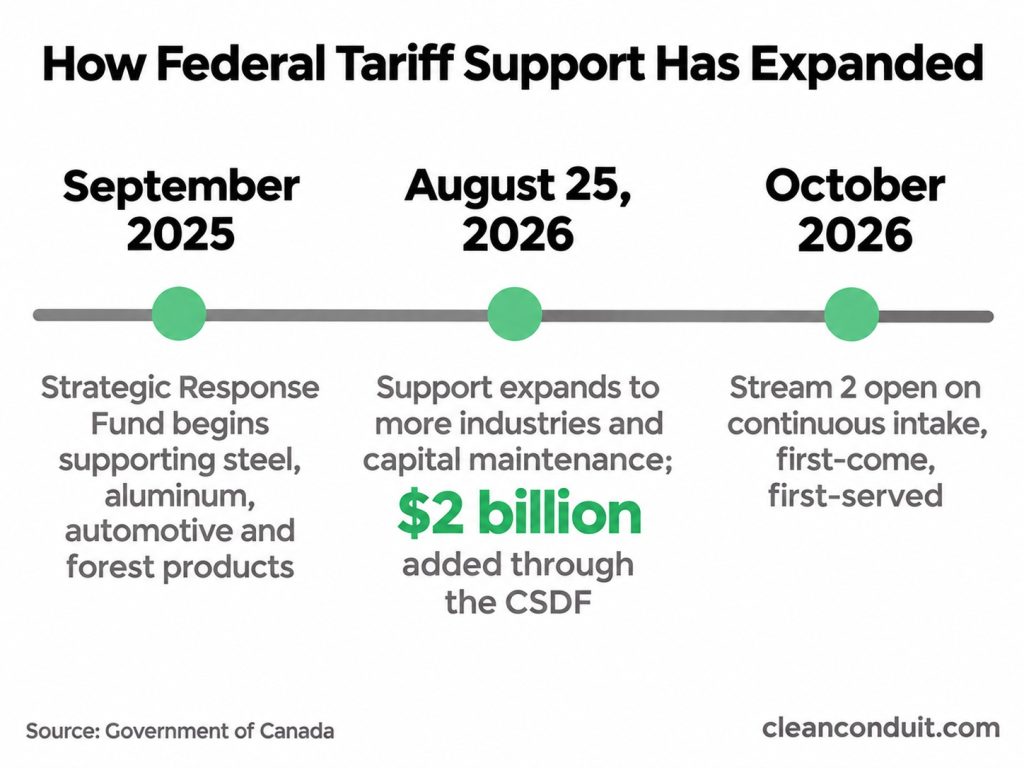
Canada Strong Diversification Fund: Two Funding Streams
The CSDF operates through two streams, each serving a different business need.
| Funding Stream | Purpose and Funding |
|---|---|
| Stream 1: Adapting, Pivoting and Diversifying | Supports investments in alternative markets, new products, industrial capabilities and productivity. Standard SRF contribution terms generally apply. |
| Stream 2: Capital Maintenance | Provides non-repayable funding requests of $5M–$30M for eligible maintenance of existing equipment and buildings, over a period of up to two years. |
Stream 1 focuses on helping companies respond strategically to changes in global trade.
Stream 2 focuses on preserving existing production capacity when businesses are affected by new U.S. Section 338 tariffs.
The appropriate stream depends on the nature of the tariff exposure, the applicant’s financial position and whether the proposed project involves business transformation or maintenance of existing capital assets.
Canadian Businesses Affected by U.S. Tariffs: Eligibility Criteria
Eligibility for the CSDF is restricted to businesses and projects meeting specific program requirements.
Being affected by U.S. tariffs does not automatically make a company eligible for funding.
Applicants must demonstrate how the trade disruption affects their business and why the proposed project is necessary to maintain domestic capacity, strengthen competitiveness or adapt operations.
Stream 1: Adapting, Pivoting and Diversifying Business Operations
Stream 1 supports Canadian businesses, including small and medium-sized businesses, investing in projects that respond to significant tariff-related challenges.
Priority sectors include:
- Steel manufacturing and processing.
- Aluminum manufacturing and processing.
- Automotive manufacturing and supply chains.
- Forest products.
- Other industries highly exposed to U.S. tariffs.
Eligible projects must connect the investment to priorities such as supporting domestic production, pivoting toward new markets, protecting jobs and improving long-term competitiveness.
The federal government prioritizes projects involving one or more of the following:
- Significant tariff exposure: Companies operating in highly trade-exposed sectors or experiencing revenue losses, reduced profitability or job losses.
- Large-scale diversification investments: Projects combining pre-development activities and capital expenditures to develop alternative products, serve new markets or improve competitiveness.
- Critical industrial capabilities: Investments necessary to maintain industrial production, skills or capabilities important to Canada’s economic security.
- Domestic market development: Projects helping businesses expand their capacity to meet Canadian demand or accelerate exports into other markets.
Projects may focus on maintaining or expanding existing industrial capabilities, creating new products and technologies for alternative markets, or investing in productivity improvements. The program also allows certain eligible pre-development activities related to retooling and market diversification.
However, these activities are not automatically eligible; each project must meet the applicable SRF requirements and demonstrate sufficient benefits for Canada.

Stream 2: Capital Maintenance to Maintain Operations
Stream 2 provides non-repayable funding to eligible businesses affected directly or indirectly by new U.S. Section 338 tariffs.
This stream is intended to help companies preserve industrial capacity by maintaining existing capital assets rather than investing primarily in new production capacity.
The federal eligibility criteria are more specific than those for Stream 1.
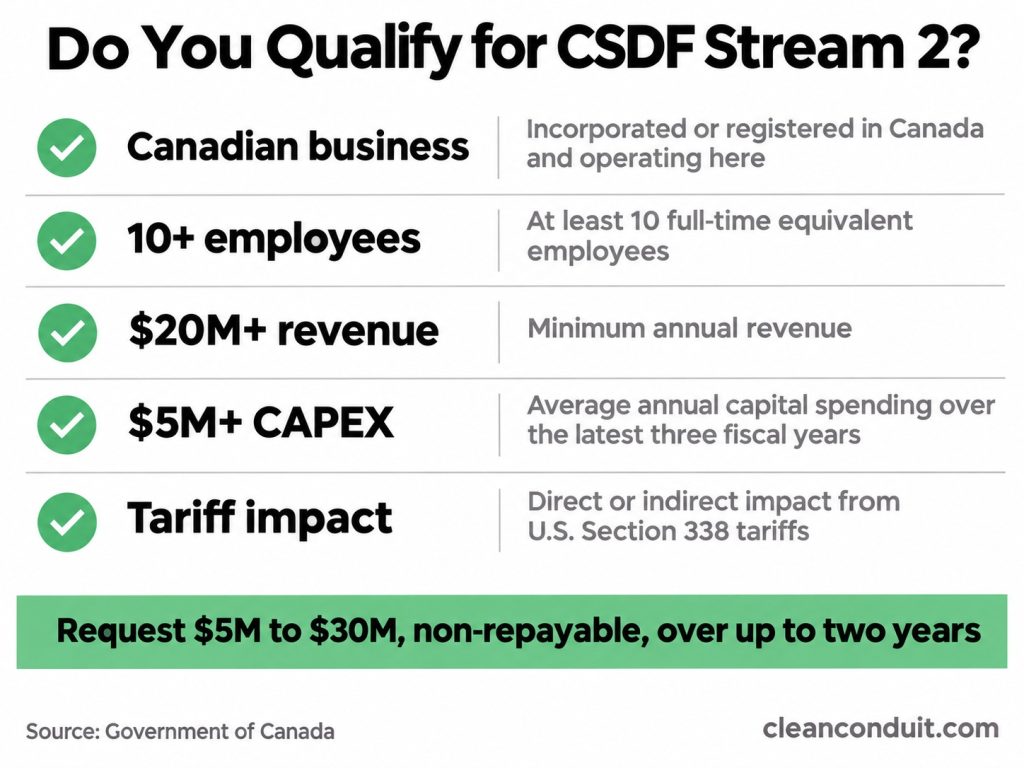
| Eligibility Requirement | Stream 2 Requirement |
|---|---|
| Canadian presence | Incorporated or registered in Canada and carrying out business in Canada |
| Employees | At least 10 full-time equivalent employees |
| Annual revenue | At least $20 million |
| Historical capital expenditures | Average annual CAPEX of at least $5 million over the latest three fiscal years |
| Tariff exposure | Demonstrable direct or indirect impact from U.S. Section 338 tariffs |
| Funding request | $5 million to $30 million |
| Funding period | Up to two years |
Eligible applicants can include for-profit and not-for-profit organizations, commercial enterprises, co-operatives, industry-led consortia and collaborative partnerships involving industry, Indigenous organizations and academia, provided all applicable requirements are satisfied.
The capital maintenance stream targets sectors including wood and paper manufacturing, plastics, machinery, electrical equipment, information and communications technology manufacturing, furniture, chemicals, food and beverage, and textiles and apparel.
Other industries may be considered as tariff measures and their economic impacts change.
Importantly, the Stream 2 eligibility rules do not apply automatically to Stream 1.
How Much Funding Is Available Through the Canada Strong Diversification Fund?
The amount and repayment conditions depend on which funding stream is used, though funding request minimums are in the millions of dollars. For smaller projects related to tariff relief, see Regional Tariff Response Initiative: Up to $3M in Non-Repayable Support.
Stream 1 Funding Amounts
Stream 1 operates within the Strategic Response Fund’s broader contribution framework.
Under standard SRF funding conditions, the minimum contribution request is $10 million for a project with at least $20 million in eligible supported costs.
SRF funding is generally repayable by default.
Non-repayable contributions may be considered for qualifying projects where due diligence confirms significant benefits for Canadians and the supported activities align with federal investment priorities.
Therefore, companies should not assume that Stream 1 funding will be non-repayable.
The actual contribution amount, eligible cost-sharing ratio and repayment requirements are determined individually.
Stream 2 Non-Repayable Funding
Stream 2 offers a more clearly defined non-repayable funding opportunity.
Eligible applicants may request between $5 million and $30 million for capital maintenance activities over a period of up to two years.
These contributions are intended to help businesses maintain existing equipment and infrastructure while responding to tariff-related financial pressure.
The requested amount is not an automatic entitlement.
Funding decisions depend on eligibility, demonstrated need, eligible expenditures, due diligence and the availability of government funding.
Approved funding conditions will be established through a contribution agreement.
Eligible Costs Under the Canada Strong Diversification Fund
Eligible costs differ substantially between the two streams.
Understanding the distinction is important when deciding whether a proposed investment is better suited to diversification funding or capital maintenance support.
Stream 1: Eligible Costs for Diversification Projects
Stream 1 can support eligible costs under the Strategic Response Fund, along with certain pre-development expenditures associated with tariff response projects.
The SRF’s general eligible cost categories include:
- Direct labour associated with approved project activities.
- Direct materials and equipment.
- Other direct project costs.
- Subcontractor and consultant expenses.
- Eligible overhead, subject to program limits.
- Necessary and reasonable land and building costs, subject to applicable conditions.
For tariff-affected businesses, Stream 1 can also support required eligible pre-development activities focused on retooling and market diversification.
The federal government specifically identifies front-end engineering and design studies as examples of these additional expenditures.
Such activities may help businesses evaluate or prepare investments intended to redirect production toward the Canadian market or alternative export markets.
The complete project scope and eligible costs must be assessed against SRF requirements.
For example, market diversification does not automatically make sales, advertising or general marketing expenditures eligible.

Stream 2: Eligible Costs for Capital Maintenance
Stream 2 has a narrower scope.
Funding is intended for the repair, replacement or restoration of existing equipment and buildings required to sustain operations.
Eligible costs may include:
- Capitalized equipment costs associated with maintaining existing capital assets.
- Capitalized building costs required to maintain existing facilities.
- Direct labour necessary to maintain capital assets.
Costs must be necessary, reasonable and related to the approved activities described in the contribution agreement.
This means ordinary operating expenses, unrelated payroll costs and general working capital should not be assumed to qualify.
For companies planning investments, the distinction is straightforward: Stream 1 focuses on adapting and diversifying operations, while Stream 2 focuses on preserving existing capital assets and production capacity.
How Clean Conduit Can Help Canadian Businesses Secure Funding
Determining whether a project qualifies for the CSDF requires more than demonstrating that a company has been affected by U.S. tariffs.
Applicants need a clearly defined investment scope, credible financial information and a compelling explanation of how the project will protect jobs, maintain operations or improve long-term competitiveness.
Clean Conduit works with business owners and management teams to evaluate government funding opportunities, develop investment plans and structure projects for funding consideration.
For companies exploring CSDF funding, Clean Conduit can help assess stream eligibility, develop project scope with management, identify potentially eligible costs, prepare financial forecasts and supporting business cases, and coordinate the documentation needed for government review.
Where the project does not align with CSDF requirements, Clean Conduit can also help businesses explore funding options through other federal and provincial programs.
Considering a capital maintenance or diversification investment? Contact Clean Conduit to discuss your project and determine which funding opportunities may be appropriate.
How to Apply for CSDF Funding
The application process depends on the selected funding stream.
Stream 1: Strategic Response Fund Application Process
Stream 1 applicants begin through the Strategic Response Fund’s standard eligibility and consultation process.
Step 1: Assess project eligibility
Review the SRF’s project requirements and confirm the proposed investment aligns with CSDF priorities.
Companies should identify the effects of tariff measures, the intended investment and the benefits expected for Canadian operations.
Step 2: Request an SRF consultation
Use the federal government’s Strategic Response Fund eligibility tool to assess the project and access the consultation process.
ISED officials can help determine whether the proposed investment is appropriate for the program.
Step 3: Develop the project scope and business case
Prepare a project description outlining the planned activities, estimated costs, financing requirements, expected outcomes and implementation schedule.
Supporting information should explain why the investment is needed and how it will improve the company’s resilience and competitiveness.
Step 4: Proceed through formal application and due diligence
Projects invited to advance may proceed through a statement of interest and full application.
The process can involve financial, technical and economic assessments, followed by negotiation of funding conditions and a contribution agreement if approved.
Stream 2: Capital Maintenance Application Process
The capital maintenance stream has a dedicated expression-of-interest process.
Businesses should first confirm that they meet the published financial, operational and tariff-impact thresholds.
They should then prepare information establishing:
- The direct or indirect impact of Section 338 tariffs.
- Existing equipment or buildings requiring maintenance.
- Historical capital expenditures.
- Proposed capital maintenance activities and costs.
- The funding requested and proposed implementation period.
- The importance of the assets to maintaining production and protecting jobs.
Eligible businesses can submit an expression of interest through the official Canada Strong Diversification Fund page.
Is the Canada Strong Diversification Fund Still Accepting Applications?
As of October 2026, Stream 2 applications are being accepted on a continuous intake basis until available funding has been fully committed.
The federal government states that Stream 2 funding is allocated on a first-come, first-served basis.
Businesses considering capital maintenance projects should therefore evaluate eligibility and develop their proposals early.
Stream 1 follows the SRF eligibility screening and application process, and applicants should consult ISED regarding the current status of their proposed project.
How the CSDF Supports the Canadian Economy
The CSDF is intended to address both immediate trade pressures and longer-term risks to Canada’s industrial competitiveness.
Canadian businesses operating in highly exposed sectors may face reduced demand, increased costs, investment uncertainty or pressure to relocate or reduce production.
By supporting domestic production, capital maintenance and investments in alternative markets, the fund seeks to preserve industrial capabilities while enabling companies to respond to changing trade conditions.
Stream 1 supports longer-term adaptation, including innovation, new products and technologies, productivity improvements and market diversification.
Stream 2 provides targeted support for existing capital assets that businesses need to continue operating.
Together, these measures are designed to help companies maintain operations, protect jobs and reduce their vulnerability to future trade disruption.
Frequently Asked Questions About the Canada Strong Diversification Fund
The Canada Strong Diversification Fund is a federal funding initiative delivered through the Strategic Response Fund to help Canadian businesses affected by U.S. tariffs.
It supports projects involving business diversification, maintaining industrial capacity, productivity improvements and capital maintenance.
Eligible businesses must operate in Canada and meet the requirements of the relevant funding stream.
Stream 1 focuses on companies operating in sectors significantly affected by U.S. tariffs and proposing projects that support domestic production, market diversification, job protection and competitiveness.
Stream 2 has additional financial and operational eligibility thresholds, including minimum revenue, employment and historical capital expenditures.
Under Stream 2, eligible businesses may request between $5 million and $30 million in non-repayable funding for capital maintenance.
Stream 1 generally follows standard Strategic Response Fund conditions, under which contributions are repayable by default and non-repayable support is considered only for qualifying projects.
Yes, Stream 1 explicitly includes small and medium-sized enterprises, although the standard SRF funding scale means projects generally need substantial eligible costs.
Stream 2 requires at least 10 full-time equivalent employees, $20 million in annual revenue and an average of $5 million in annual capital expenditures over the latest three fiscal years.
Businesses below these thresholds can explore other funding options, including the Regional Tariff Response Initiative.
Yes, subject to the applicable stream’s requirements.
Stream 1 can support eligible capital expenditures associated with business adaptation, diversification and competitiveness.
Stream 2 specifically supports eligible costs for maintaining existing capital equipment and buildings, including qualifying direct labour associated with capital asset maintenance.
Potentially.
Stream 2 expressly allows businesses to demonstrate either direct or indirect impacts from U.S. Section 338 tariffs, provided they meet the remaining eligibility criteria.
Stream 1 prioritizes businesses in highly trade-exposed sectors and projects that respond to significant tariff-related impacts.
The government explicitly states that Stream 2 uses continuous intake and allocates available funding on a first-come, first-served basis until funding is fully committed.
This should not be interpreted as a blanket rule governing all Stream 1 applications.
Under Stream 2, businesses can request funding for eligible capital maintenance over a period of up to two years.
The support is intended to help preserve existing assets and sustain production, not to provide unrestricted operating assistance.
No.
Despite its name, the Canada Strong Diversification Fund is not a mutual fund or public investment product available to individual investors.
It is a federal economic development funding program supporting eligible Canadian businesses and projects.
Explore Canada Strong Diversification Fund Opportunities
For Canadian businesses affected by U.S. tariffs, the Canada Strong Diversification Fund offers an opportunity to offset certain costs associated with maintaining production capacity or adapting to changing trade conditions.
Its two streams address distinct needs: Stream 1 supports investments in diversification and competitiveness, while Stream 2 offers targeted non-repayable capital maintenance funding.
Businesses considering an application should begin by assessing their tariff exposure, reviewing the relevant eligibility criteria and defining a project that aligns with the program’s investment priorities.
Developing the investment scope and supporting financial case early can help management determine whether CSDF funding is appropriate and prepare for the federal review process.
Program information reviewed October 29, 2026. Eligibility, available funding and application requirements may change.