Manufacturers in southern Ontario often reach a point where business growth requires a significant investment. A company may need new production equipment, automation, additional capacity, certifications or support entering a new market.
The business case may be sound, but the cost and timing of the investment can still make the project difficult to finance.
The Federal Economic Development Agency for Southern Ontario, commonly known as FedDev Ontario, provides funding programs that can help established businesses make these investments.
FedDev Ontario is one of Canada’s regional development agencies and works with businesses and organizations to support innovation, community development and economic growth across southern Ontario.
As a populous region with a large manufacturing base, southern Ontario contains major industrial clusters, growing technology companies and supply chains stretching across the Greater Toronto Area and into communities farther east and west.
FedDev Ontario uses federal resources to support projects that can strengthen this regional economy.
Manufacturers are often a strong fit because their projects can produce measurable improvements in productivity, production capacity, sales, exports and job creation.
FedDev Ontario funding can help businesses grow and compete, but it is generally intended for defined projects with clear economic outcomes rather than ordinary operating expenses or routine equipment replacement.
The agency also supports clean growth. Projects involving clean technology, more sustainable production processes, waste reduction, emissions reduction and other sustainable business models may align with FedDev Ontario priorities where they also meet the requirements of the applicable funding stream.
Businesses considering funding today should confirm that the program they are targeting is open and that their project is eligible before making major commitments. Intake periods and program priorities can change.
Contact FedDev Ontario for current intake periods and guidance if the status of a program is unclear.
As of October 2026, the principal FedDev Ontario funding options relevant to manufacturers include:
the Regional Tariff Response Initiative;
Funding for Businesses in Southern Ontario; and
the Regional Defence Investment Initiative, whose intake is currently paused.
Regional Tariff Response Initiative
The Regional Tariff Response Initiative, or RTRI, supports southern Ontario businesses affected by tariffs and related trade disruptions.
The program provides two main types of support for businesses:
liquidity assistance to help tariff-affected companies maintain Canadian operations and employment during periods of short-term financial pressure; and
pivot project funding for investments that improve productivity, strengthen supply chains, diversify markets and reduce exposure to future trade disruptions.
Businesses may apply for liquidity assistance, pivot project funding or both, subject to program requirements.
RTRI is available to businesses across tariff-impacted sectors.
Who Is Eligible for the Regional Tariff Response Initiative?
To be eligible, a business must generally:
be an incorporated, for-profit business located and operating in southern Ontario;
have at least $1 million in annual revenue in one or both of its last two fiscal years;
have been financially viable before the tariff impacts affecting the business; and
demonstrate direct or indirect exposure to tariffs or related trade disruption.
Tariff exposure can take several forms. A business may export directly into a tariff-affected market, supply another company that exports affected goods, rely on imported materials whose costs have increased because of tariffs, or experience other significant trade-related disruptions.
Evidence of an impact could include:
increased material or component costs;
supply-chain disruptions or longer lead times;
reduced exports;
lost customers or sales;
declining margins; or
other measurable financial pressures related to tariffs or trade disruption.
Businesses with at least 25% of their revenue coming from goods ultimately exported to the United States may also be able to demonstrate significant tariff exposure.
Applicants should be prepared to support their claims with financial statements, sales information, supplier quotations, customer correspondence, payroll records or other relevant documentation.
A general statement that tariffs have created uncertainty is unlikely to demonstrate sufficient impact on its own.
Liquidity Assistance: Up to $2 Million Non-Repayable
RTRI provides temporary non-repayable liquidity assistance for tariff-affected businesses that need short-term support to maintain Canadian operations and employment.
Unlike most FedDev Ontario project funding, liquidity assistance can support certain existing operating expenses rather than only new or incremental project costs.
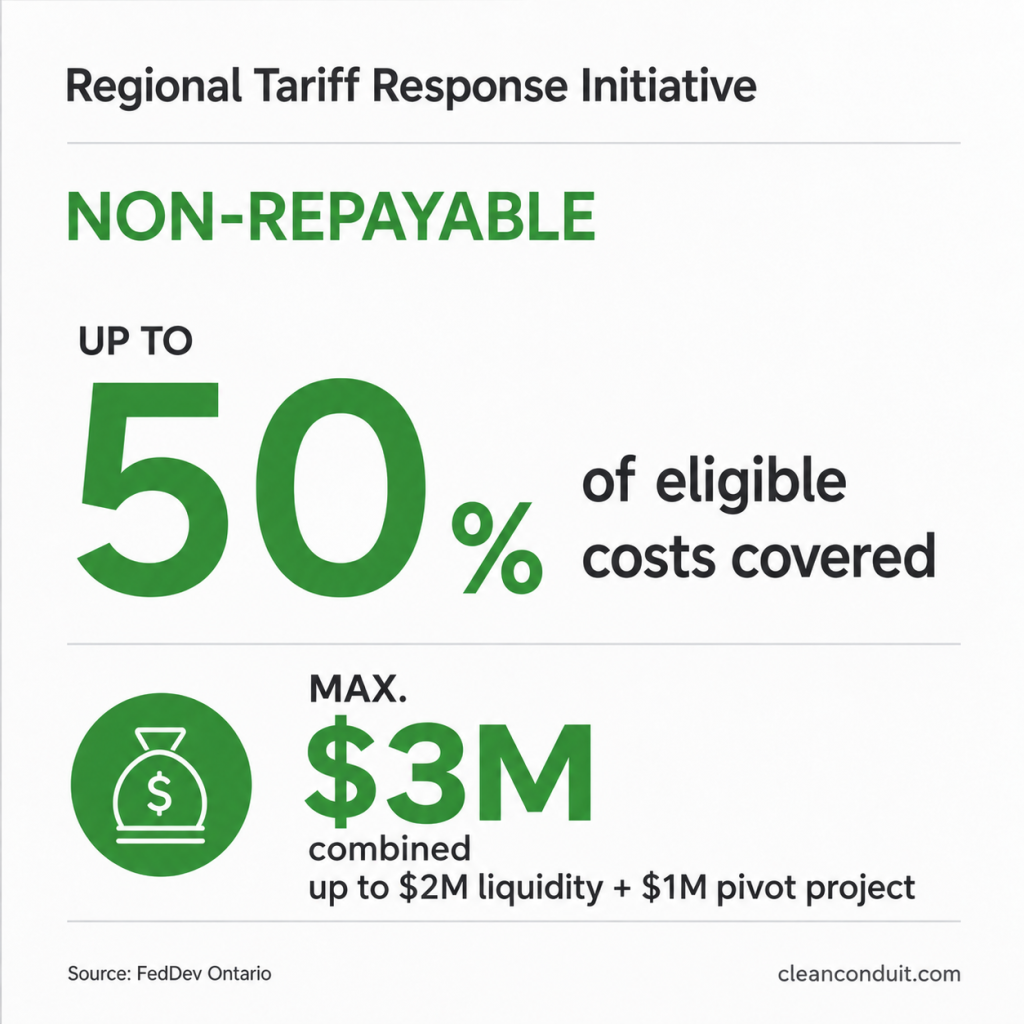
Funding is generally calculated based on 50% of the business’s average eligible monthly payroll for up to 12 months, to a maximum contribution of $2 million.
Liquidity assistance must end no later than March 31, 2028.
Where payroll-based assistance does not adequately address a demonstrated liquidity need because the business has significant essential operating expenses, FedDev Ontario may also consider up to 50% of certain operating costs on an exceptional basis.
These costs are limited to:
rent or commercial lease payments;
utilities;
business insurance; and
property taxes.
Applicants must demonstrate that the liquidity requirement is related to tariff or trade disruption. FedDev Ontario may require payroll records, financial statements, cash-flow forecasts and other evidence showing the company’s need for support.
Tariffs and customs duties themselves are not eligible. Other costs such as raw materials, inventory, capital purchases, debt repayments and interest are also outside the purpose of liquidity assistance.
A business may apply for liquidity assistance on its own or alongside a pivot project. Existing RTRI recipients may also be eligible for liquidity support, provided the same costs are not funded twice.
RTRI Pivot Projects
Pivot projects provide funding for businesses making longer-term investments to become more productive, competitive and resilient.
The proposed project should directly respond to the trade-related challenge facing the company and demonstrate how the investment will reduce risk or improve the company’s ability to compete.
Eligible activities may include:
purchasing or adopting productivity-enhancing equipment and technology;
automating or digitizing production processes;
modernizing manufacturing operations;
adapting processes to use alternative materials or inputs;
developing or qualifying new suppliers;
strengthening Canadian supply chains;
increasing domestic production capacity;
completing market diagnostics;
developing products for new markets;
expanding into new domestic or international markets;
participating in trade missions;
building strategic partnerships;
meeting standards required to enter new markets; and
reducing dependence on a heavily affected export market or supply chain.
RTRI can also support activities that bring research and development mandates, specialized expertise or highly qualified people to southern Ontario.
For example, a manufacturer facing higher costs for imported components could invest in equipment that allows those components to be produced domestically.
Another business could automate a labour-intensive production process to offset increased input costs and remain competitive.

What Costs Are Eligible for RTRI Pivot Projects?
Pivot project costs must be reasonable, incremental and directly related to the approved project.
Depending on the project, eligible expenses may include:
equipment and technology;
implementation and installation costs;
incremental labour;
specialized expertise or professional services;
market development activities; and
other costs directly required to complete the approved activities.
Ongoing operating expenses cannot normally be included in a pivot project budget. Businesses seeking support for existing payroll or specified recurring operating expenses should instead consider the liquidity assistance component of RTRI.
Costs incurred before FedDev Ontario makes a funding decision remain at the applicant’s risk.
For pivot projects, eligible costs may be considered for activities beginning up to 12 months before the application is submitted.
All pivot project activities and costs must be completed no later than March 31, 2029.
Retroactive eligibility does not guarantee that an expense will ultimately be approved.
How Much RTRI Funding Is Available?
Funding depends on whether the business is seeking liquidity assistance, non-repayable pivot funding or repayable pivot funding.
Liquidity Assistance
Businesses may receive:
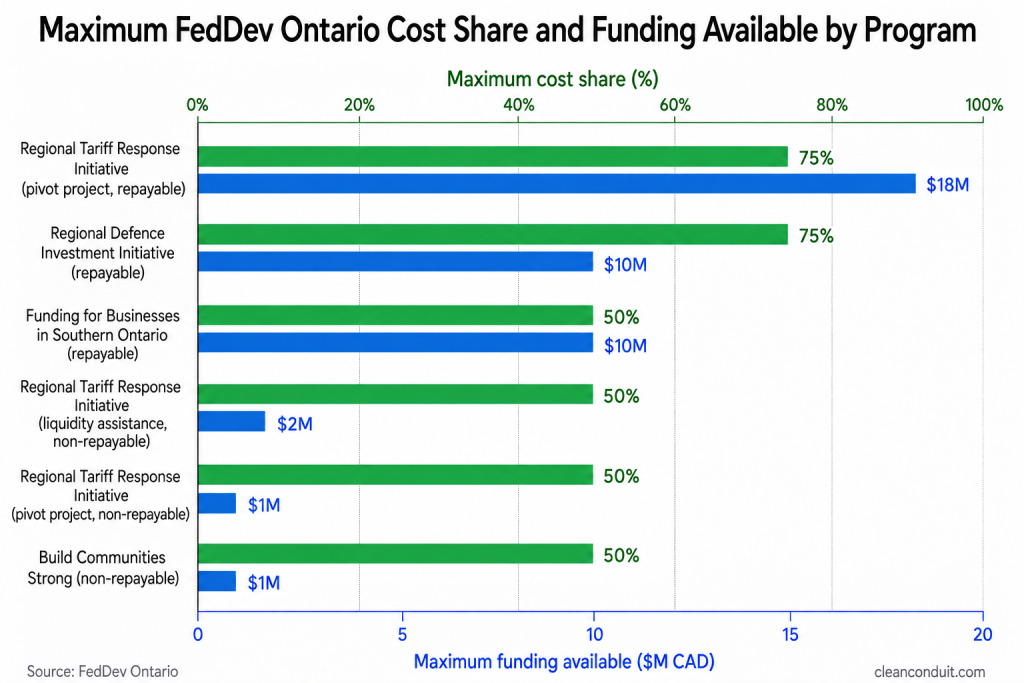
up to $2 million in non-repayable funding;
generally up to 50% of eligible costs; and
support for up to 12 months, ending no later than March 31, 2028.
Non-Repayable Pivot Funding
Businesses undertaking pivot projects with broader local or regional economic benefits may receive:
up to $1 million in non-repayable funding; and
generally up to 50% of eligible project costs.
Broader economic benefits could include maintaining employment, strengthening an important supply chain, preserving Canadian production, creating economic value within the region or supporting the economic base of a community.
Repayable Pivot Funding
Larger-scale or more transformative projects may receive repayable assistance:
for funding requests above $1 million; and
generally covering up to 75% of eligible project costs.
When repayable funding is included, a business may receive up to $20 million in total RTRI assistance across its RTRI project components.
A business may receive up to $3 million in combined non-repayable RTRI funding, consisting of:
up to $2 million in liquidity assistance; and
up to $1 million for a non-repayable pivot project.
For pivot projects, combined federal, provincial and municipal government assistance will normally not exceed 90% of eligible project costs.
Indigenous-led projects may be eligible for government assistance covering up to 100% of eligible costs.
Funding for Businesses in Southern Ontario
FedDev Ontario’s general business funding stream supports established companies undertaking substantial growth, commercialization, productivity or market expansion projects.
For many manufacturers, the question is not simply whether funding exists but whether it is the right time to apply.
A company should normally have a defined project, credible costs, a clear implementation plan and enough financial resources to fund its share of the investment.
Who Is Eligible?
Eligible applicants generally include growing or established for-profit businesses, co-operatives and Indigenous businesses that:
are located and operating in southern Ontario;
have a minimum of five full-time employees;
have no more than 500 full-time equivalent employees overall; and
have been incorporated and registered to do business in Canada or Ontario for at least three years.
In practice, this means the program is designed for operating companies with an established financial and employment history. It is not normally a fit for a pre-revenue startup with only its founders working in the business.
What Manufacturing Projects Can FedDev Ontario Support?
The program supports three broad categories of activities.
The first is the development, commercialization or production of innovative products, processes and services. This may include late-stage product development, operational demonstrations, market studies and process improvements that reduce the environmental impact of existing operations.
Basic research is not eligible. Product development projects are normally expected to be relatively close to market, generally within technology readiness levels 7 to 9.
The second category is productivity and capacity improvement. For a manufacturer, this could include:
adopting automation, robotics or digitized production systems;
purchasing or adapting advanced manufacturing equipment;
improving production efficiency;
increasing plant capacity;
introducing clean technologies;
adopting more sustainable business models or production processes;
making process improvements;
completing related facility enhancements; or
training employees to operate new equipment and production systems.
FedDev Ontario’s broader clean-growth priorities can also support projects focused on the adoption or commercialization of clean technology, reduction of waste or emissions, circular economy activities and other investments that combine business growth with measurable environmental outcomes.
The third category is business expansion. Projects may involve launching a new product, integrating into domestic or international supply chains, entering new markets, reaching new customers or bringing production and technical capabilities back to southern Ontario.
A manufacturer installing an automated production line, for example, should explain more than the specifications and cost of the machinery.
The application should demonstrate how the investment will increase output, reduce unit costs, improve quality, support innovation, create or maintain jobs and generate additional sales.
What Costs Are Eligible?
Eligible costs must be reasonable, verifiable, incremental and directly related to the proposed project.
Depending on the project, costs may include:
machinery, equipment and production software;
installation of specialized equipment;
incremental employee salaries and benefits;
engineering, technical and other specialized expertise;
project management costs; and
renovations or leasehold improvements required for the installation of project equipment.
Costs associated with normal production or ongoing operations are not eligible.
Other common exclusions include purchasing land or buildings, basic and applied research, refinancing existing debt, routine capital replacement and expenses that are not directly connected to the approved activities.
Manufacturers should distinguish between a facility improvement required to install specialized equipment and a general building expansion.
Electrical work, foundations or ventilation needed for a new production line may form part of an eligible project. Constructing a larger building without a direct connection to the funded equipment and activities is more difficult to justify.
Projects starting before the application is submitted should also be approached carefully. Under the general business stream, costs incurred before submission are not eligible.
How Much FedDev Ontario Funding Is Available?
Businesses normally request between $125,000 and $10 million per project. Assistance is provided as an interest-free, repayable contribution rather than a grant.
FedDev Ontario normally contributes up to 50% of eligible project costs. Preference may be given to projects that require a lower percentage and have secured more financing from the applicant, lenders, investors or other sources.
Repayment normally begins one year after the project is completed. The repayment schedule is set out in the contribution agreement, and there is no penalty for early repayment.
Stacking federal, provincial and municipal assistance is generally limited to:
50% of eligible capital costs; and
75% of eligible non-capital costs.
A manufacturer requesting $1 million from FedDev Ontario would therefore normally require a project with at least $2 million in eligible costs and credible evidence that it can finance its share.
FedDev Ontario funding may sometimes be combined with other government programs, grants or tax credits, but all sources of government assistance must be disclosed.
Applicants should examine both the FedDev Ontario stacking limit and the rules of other programs before obtaining additional public funding for the same project.
Can a Business Submit More Than One FedDev Ontario Application?
Businesses need to pay particular attention to FedDev Ontario’s application rules.
A business with an active FedDev Ontario project may propose a new project, but the new application must be distinct and separate from the existing project.
More importantly, the current rules generally allow a business to submit only one application to FedDev Ontario at a time across open programs.
In other words, manufacturers should not assume that one application is allowed for every active project or that they can submit concurrent applications to several FedDev programs.
Before choosing between programs, determine which project and funding stream should receive priority.
Contact FedDev Ontario if there is uncertainty about an existing project, a pending application or the timing of a proposed new submission.
Regional Defence Investment Initiative
The Regional Defence Investment Initiative, or RDII, supports companies entering or expanding within Canadian and allied defence supply chains.
The program is particularly relevant to manufacturers involved in aerospace, shipbuilding, advanced materials, sensors, cybersecurity, artificial intelligence, autonomous systems, specialized vehicles, personnel protection and critical minerals or metals.
The intake for businesses is currently paused. However, RDII remains relevant to manufacturers planning a longer-term defence investment or preparing for a future intake.
Because program status can change, companies should contact FedDev Ontario for current intake periods before developing an application around an assumed reopening date.
FedDev Ontario also works more broadly to help local suppliers understand and integrate into defence supply chains.
This includes initiatives and advisory resources that connect southern Ontario businesses with defence opportunities, procurement requirements, certifications and larger contractors.
Who Is Eligible for Defence Funding?
Eligible businesses must be incorporated, located and operating in southern Ontario and employ at least five full-time equivalent employees in the region.
Applicants must already participate in defence supply chains or have a credible plan to enter them.
A project must address a demonstrated defence opportunity or military need and increase Canada’s industrial, technological or innovation capacity.
Dual-use products and technologies may qualify, but the military application must be clearly demonstrated. It is not enough to state that a commercial product could theoretically be used by the defence sector.
The applicant should identify the relevant defence customer, application, standard, procurement opportunity or capability requirement.
What Defence Activities Can Be Supported?
Eligible activities may include:
digitization, automation and technology integration;
acquiring specialized manufacturing equipment;
expanding or modernizing production facilities;
obtaining certifications needed to compete for defence work;
developing commercialization and defence market-entry strategies;
adapting or improving technologies with civilian and military applications; and
completing late-stage product development for a defence application.
A manufacturer might, for example, obtain an aerospace or defence quality certification, purchase specialized machining equipment and qualify a component for a Canadian or allied defence supply chain.
For local suppliers, these investments can increase their chance of qualifying for opportunities with larger defence contractors and government procurement programs.
How Much Defence Funding Is Available?
Under the published RDII parameters, businesses can normally request between $125,000 and $10 million in interest-free, repayable funding.
FedDev Ontario may contribute up to 75% of eligible project costs, with the applicant and other sources providing at least 25%. Total government assistance may cover up to 100% of eligible costs.
Costs may be recognized retroactively for up to 12 months before receipt of the signed application, but no earlier than April 1, 2025.
Approved projects must be completed by March 31, 2029.
These parameters do not mean applications are currently being accepted. Businesses interested in RDII should confirm the intake status with FedDev Ontario.

What About Funding for Not-for-Profit Organizations?
FedDev Ontario also funds not-for-profit and community development organizations that help businesses grow, develop regional industries and deliver services to companies.
These organization-focused programs are different from funding awarded directly to an individual manufacturer.
A manufacturer may still benefit indirectly through an accelerator, industry association, innovation centre or other organization delivering a FedDev-supported program.
For organization-led projects, strengthening regional business ecosystems is an important part of program fit.
Eligible initiatives may bring together multiple businesses and partners, improve access to specialized services or technology, develop regional clusters, help companies enter supply chains or otherwise create benefits extending beyond a single company.
Projects in these streams should be able to explain how the proposed activities strengthen the regional business ecosystem and generate measurable benefits for the businesses or communities being served.
This type of ecosystem support can also apply to defence. FedDev Ontario funds initiatives and provides services intended to help local suppliers understand opportunities, meet industry requirements and integrate into Canadian defence supply chains.
The Build Communities Strong Fund – Local Impact Stream is another separate FedDev Ontario initiative. It supports incorporated not-for-profit organizations, Indigenous organizations, municipalities, local governments and business improvement areas undertaking community infrastructure projects designed to strengthen communities and local economies.
It is not a direct funding program for a private manufacturing company. Funding under the stream normally ranges from $125,000 to $1 million, is non-repayable and may cover up to 50% of eligible project costs.
The summer 2026 intake is no longer accepting applications. Future intakes may be announced subject to program priorities and available funding.
What Makes a Strong FedDev Ontario Manufacturing Project?
FedDev Ontario does not fund equipment simply because a manufacturer wants newer machinery. The equipment is a means to an economic result.
Applications are evaluated based on strategic alignment, economic impact and feasibility.
A competitive project should connect each major cost to measurable outcomes such as:
increased production capacity;
reduced unit costs or lead times;
improved product quality;
commercialization of a new product or innovation;
increased Canadian content;
new domestic or export sales;
stronger supply-chain resilience;
reduced waste, energy use or emissions; and
jobs created or maintained.
The company must also demonstrate that it has the management team, technical expertise, financing and working capital needed to complete the project.
FedDev Ontario funding is generally reimbursed after approved expenses have been incurred and claimed. A company must therefore be able to manage the project’s cash flow while it waits for reimbursement.
It must also confirm its sources of financing and sign a contribution agreement within the required period after being notified of approval.
Strong applications usually answer five practical questions:
What investment is the manufacturer proposing?
Why does the project need to proceed now?
What measurable economic results will it produce?
How will the company finance and manage the project?
Why is FedDev Ontario support needed for the investment to proceed at the proposed scale or pace?
Answering these questions clearly gives evaluators a better chance to understand the economic case for the project.
When Is the Right Time to Apply for FedDev Ontario Funding?
The right time to consider an application is generally before the business has committed to major project costs and after the company has developed a sufficiently detailed investment plan.
A manufacturer should ideally understand:
the equipment, technology or activities it intends to undertake;
the expected project costs;
how much funding the business can contribute;
the project schedule;
expected productivity, revenue and employment outcomes;
why the project is strategically important; and
whether the applicable FedDev Ontario intake is currently open.
Companies should not rush an application simply because a program exists today. A poorly defined project can be difficult to assess and may not show why public funding is necessary.
At the same time, waiting until equipment has already been ordered or project activities have started can create eligibility problems under programs where pre-application costs are not eligible.
How to Check Current FedDev Ontario Funding Opportunities
FedDev Ontario programs, priorities and intake periods can change. Manufacturers should confirm current information before relying on an older funding article or program summary.
The most reliable approach is to:
review the current FedDev Ontario program page;
contact FedDev Ontario about current intake periods;
confirm whether the business and project meet the applicable eligibility criteria;
verify which costs can be incurred and when;
confirm whether another pending or active FedDev Ontario application affects eligibility; and
review any updated application guide before submitting.
Businesses can also follow official FedDev Ontario and Government of Canada social channels to learn about program announcements and other economic development topics.
Where email updates are offered, companies may choose to subscribe so they are more likely to see future intake announcements.
A federal wordmark or other symbol of the government on an older document should not be taken as evidence that a program is still open.
Always follow the current program guidance and confirm time-sensitive requirements directly with FedDev Ontario.
Using a Consultant to Apply for FedDev Ontario Funding
Companies may also choose to work with an experienced funding consultant when preparing a FedDev Ontario application.
These applications typically require more than a description of the equipment being purchased or the amount of funding requested.
A strong submission should clearly explain the business case for the project, identify the eligible activities and costs, demonstrate how the project aligns with FedDev Ontario’s priorities, and quantify expected outcomes such as increased production capacity, productivity gains, new sales, exports, job creation, environmental improvements or supply-chain benefits.
A consultant can help organize this information into a clear and persuasive application, identify gaps before submission, and ensure that the project budget, timelines and expected results are presented consistently across the application and supporting documents.
This can be particularly useful for larger manufacturing projects involving multiple cost categories, financing sources or government funding programs.
FedDev Ontario funding can be valuable, but it works best for manufacturers that already have a defined project, a credible market opportunity and a realistic plan for financing their share.
Companies considering an application should review current program information, confirm eligibility and contact FedDev Ontario before committing to major project costs.
Clean Conduit can assist manufacturers with preparing and writing FedDev Ontario funding applications, including project scoping, eligibility review, budget development, application writing, financial and project information gathering, and preparation of supporting materials.
Clean Conduit can also help position a project within a broader funding strategy where other grants, loans or tax credits may be available.