Ontario automotive suppliers face growing pressure to automate production, improve productivity, control costs and respond faster to changing OEM requirements.
For eligible manufacturers, the Ontario Automotive Modernization Program (O-AMP) can help offset the cost of making those investments.
O-AMP is an Ontario government funding program designed for small and medium-sized businesses in the province’s automotive supply chain.
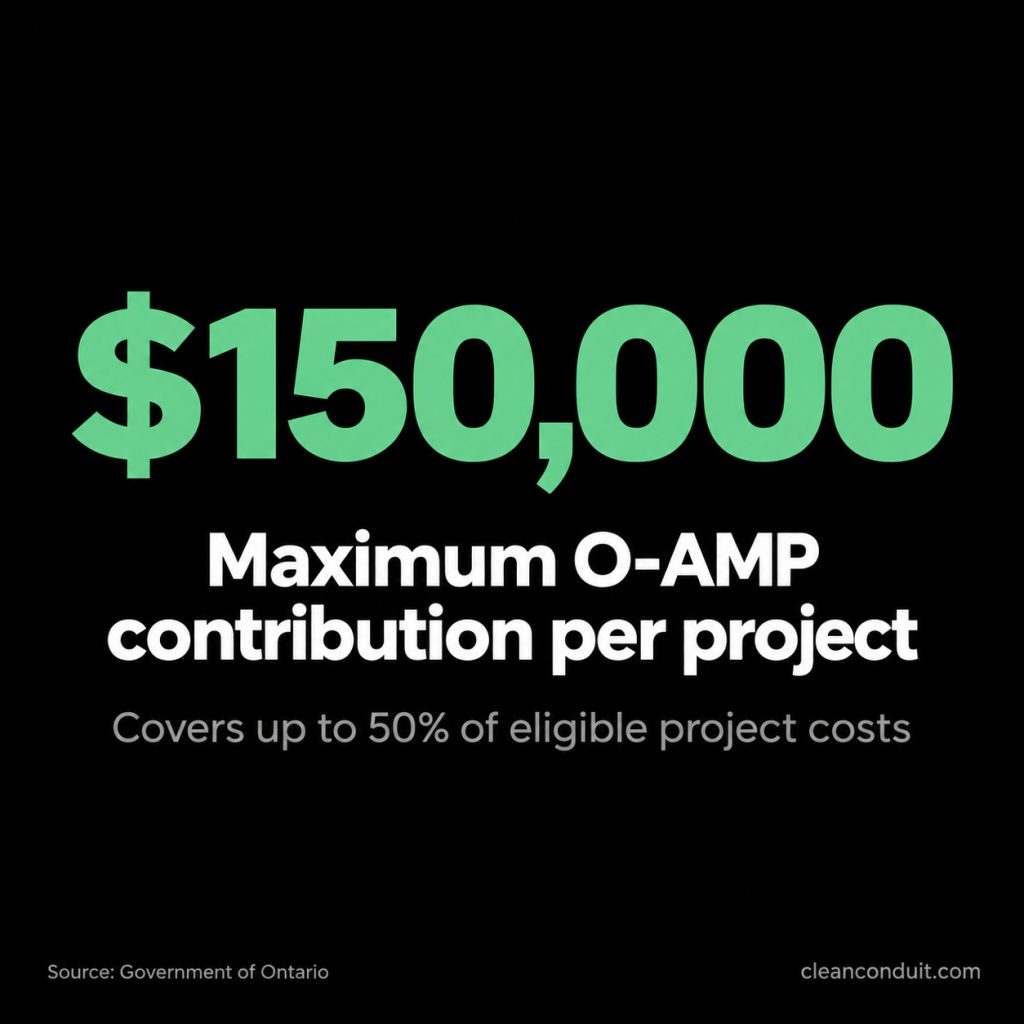
Eligible companies can receive up to $150,000 from the O-AMP grant, covering as much as 50% of eligible project costs, for projects involving advanced manufacturing technology, product development tools and lean manufacturing improvements.
The 2026 Round 7 application period ran from March 4 to April 16, 2026 and is now closed. Ontario states that information about the next intake will be announced at a later date.
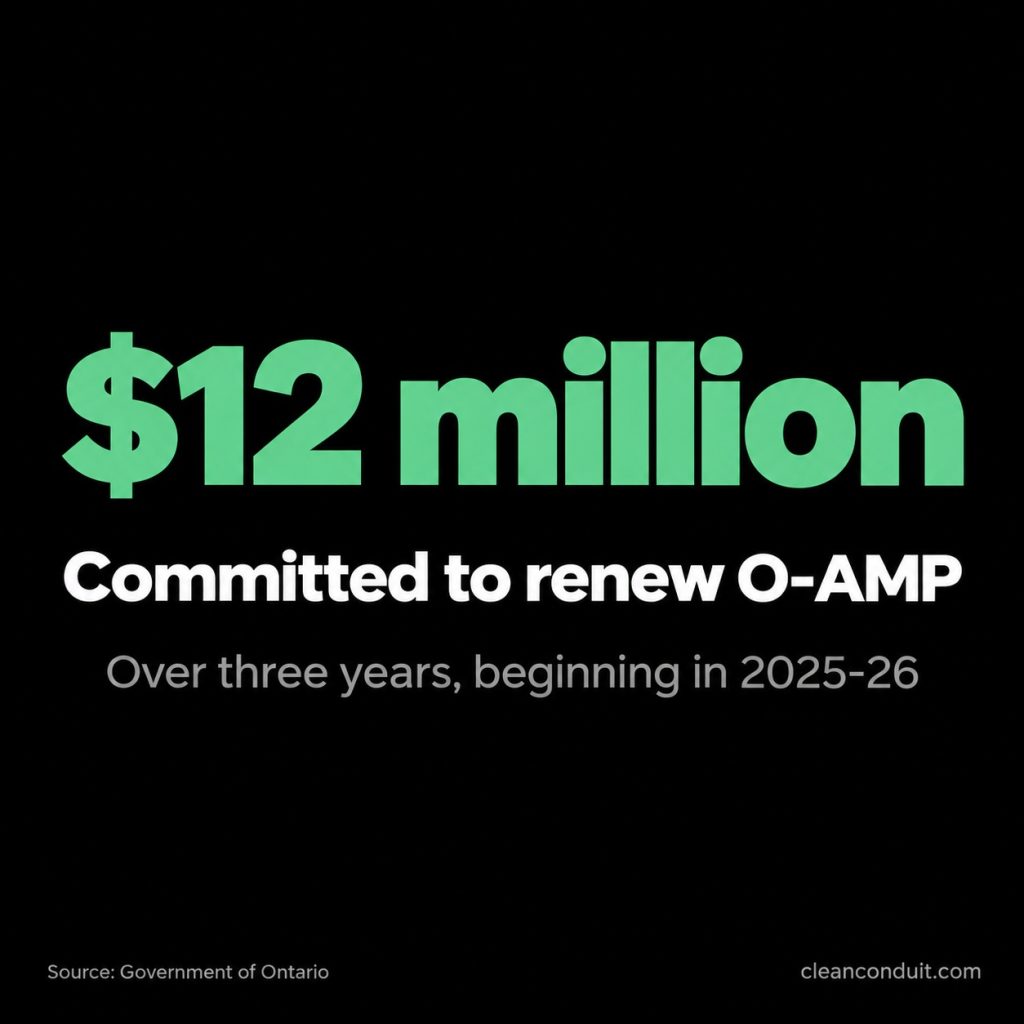
However, the province committed an additional $12 million over three years beginning in 2025-26 to continue O-AMP, making it worthwhile for manufacturers considering modernization projects to prepare before another intake opens.
What Is the Ontario Automotive Modernization Program?
The Ontario Automotive Modernization Program is intended to strengthen Ontario’s automotive supply chain by helping manufacturers become more productive, innovative and globally competitive.
Rather than funding routine operating expenses, O-AMP is focused on projects that materially improve a company’s manufacturing capabilities.
That may mean implementing advanced manufacturing hardware, introducing production tracking systems, adopting new process technology, improving product development capabilities or redesigning a manufacturing process around lean manufacturing principles.
The program’s broader objectives include reducing production costs and bottlenecks, shortening design cycles, increasing manufacturing capabilities and helping Ontario suppliers respond more effectively to new opportunities with original equipment manufacturers.
For Round 7, Ontario also indicated an interest in proposals incorporating artificial intelligence and AI-related knowledge, including technologies such as predictive analytics and computer vision.
Manufacturers preparing for a future round should confirm whether AI remains a stated priority when the next program guidelines are released.
How Much O-AMP Funding Can a Manufacturer Receive?
O-AMP can provide an eligible manufacturer with up to $150,000 toward a project and cover up to 50% of eligible project costs.
This means a company seeking the maximum $150,000 contribution would generally need a project with at least $300,000 in eligible costs.
The applicant must finance at least the remaining 50% through internal business resources, private financing or bank financing.
Manufacturers also need to consider government funding stacking rules. O-AMP cannot be stacked with another Ontario provincial funding program for the same project.
Federal assistance may potentially be combined with O-AMP, but the combined federal funding and O-AMP contribution cannot exceed 50% of the project’s total eligible costs.
A company already receiving Ontario funding for an unrelated project may still be eligible, provided the O-AMP project is clearly separate.
Who Is Eligible for O-AMP in Ontario?
O-AMP is targeted specifically at small and medium-sized companies operating within Ontario’s automotive supply chain.
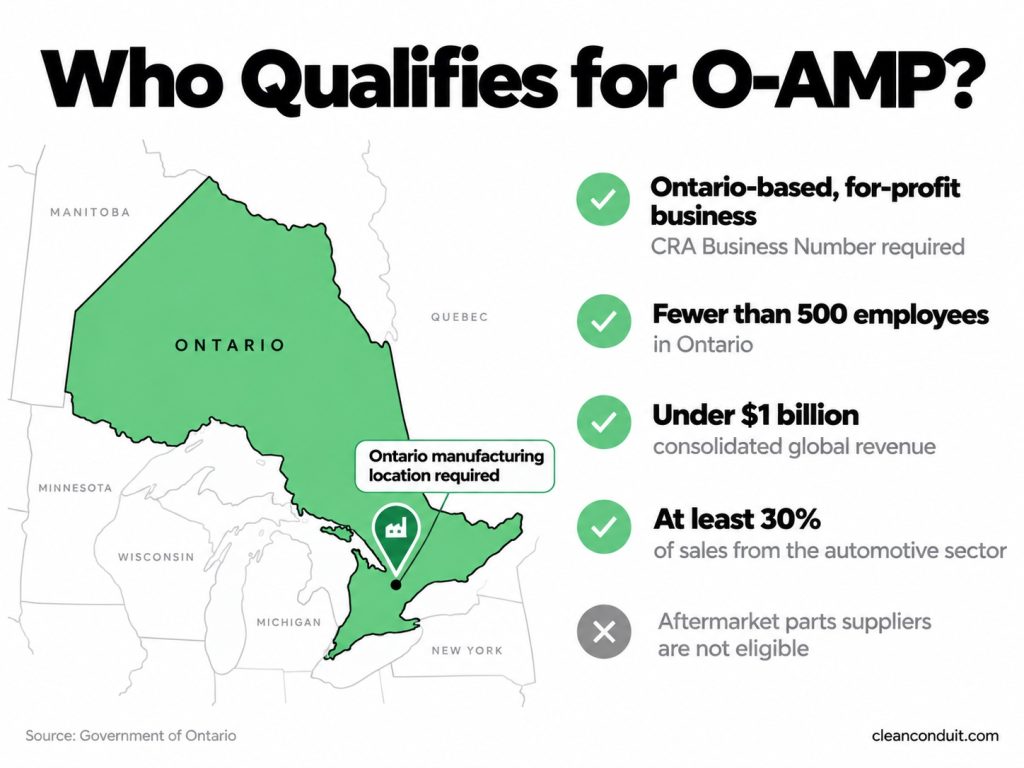
Under the current program criteria, an applicant generally needs to be a for-profit Ontario-based business with a CRA Business Number, have fewer than 500 employees in Ontario, have less than $1 billion in consolidated global revenues, and generate at least 30% of the company’s total sales revenue from the automotive sector.
The business must also have an Ontario manufacturing location in place when the project begins.
Eligible businesses must participate in the automotive supply chain serving original equipment manufacturers of passenger and commercial vehicles.
This can include automotive parts suppliers, manufacturers of production machinery, software providers and companies supplying related technologies.
Suppliers serving the electric vehicle ecosystem can also qualify. Ontario’s guidelines include businesses supplying products, components, software or technology used in EVs or EV batteries.
The aftermarket parts industry is not eligible under the current rules.
Applicants must also be compliant with applicable Ontario requirements, including tax obligations and the Accessibility for Ontarians with Disabilities Act.
What Types of Projects Does O-AMP Support?
A strong O-AMP project should do more than simply replace aging equipment. The applicant needs to demonstrate how the investment will create measurable operational or economic improvements.
The program currently identifies three broad project areas.
Technology Adoption for Process Efficiency
Technology adoption for process efficiency can include advanced manufacturing hardware, software and training that improve production processes.
Examples can include:
Advanced manufacturing hardware and software
Enterprise resource planning systems
Production tracking systems
Predictive analytics
Computer vision
Automation technologies
New process technology
Other tools that improve operational efficiency
An advanced hardware implementation project should clearly explain how the equipment or technology will improve processes, reduce costs, increase output or address another measurable production issue.
Tools and Technologies to Support New Product Development
O-AMP can also support tools and technologies that help manufacturers accelerate engineering, design and product introduction.
Examples may include computer aided design, computer aided manufacturing, CAD/CAM systems, finite element analysis software, Design for Manufacturing tools and rapid prototyping tools.
These technologies can help automotive parts suppliers reduce development time, improve design capabilities and respond more quickly to opportunities in the auto supply sector.

Lean Manufacturing Projects
Lean manufacturing projects can focus on reducing waste, addressing bottlenecks, improving throughput and creating more efficient manufacturing processes.
A project might involve adopting lean manufacturing techniques, changing production layouts, standardizing processes or working with specialized lean expertise.
The strongest lean implementation projects connect these activities to measurable outcomes such as shorter cycle times, lower scrap rates, increased production capacity or reduced labour requirements.
Projects can also combine more than one category. For example, a manufacturer might introduce automated inspection equipment, implement production analytics and redesign the associated workflow using lean manufacturing practices.
Eligible projects can be up to two years in duration.
What Costs Can O-AMP Cover?
Eligible project costs must be directly related to completing the approved project and considered reasonable and necessary by the province.
Current guidelines allow certain capital costs, including the purchase, implementation, installation and setup of manufacturing, engineering, design, prototyping or logistics hardware and software.
Depending on the project, eligible expenses may include:
Advanced manufacturing hardware implementation
Manufacturing and engineering software
Project-specific software licences
Production tracking systems
Equipment installation and configuration
Materials required for testing production processes
Training associated with new technology
Certain incremental employee costs directly related to the project
Specialized support for eligible lean manufacturing projects
Some project-related consultant expenses can be eligible, particularly specialized expertise associated with lean implementation.
However, consulting fees incurred simply to prepare the O-AMP application are not eligible project costs.
Routine operating expenses, maintenance, insurance, financing charges, taxes, refinancing, acquisitions and ordinary management salaries are among the costs that generally cannot be claimed.
Because cost eligibility can determine the size of the eventual contribution, applicants should build their project budgets around the current eligible-cost guidelines rather than assuming every modernization expense will qualify.
What Financial Documents Are Required?
Financial readiness is an important part of an O-AMP application.
Ontario currently asks applicants to provide financial statements for the two most recently completed consecutive fiscal years as separate documents.
Audited financial statements are preferred, while review engagement financial statements prepared under the applicable Canadian standards can also be accepted.
Businesses with less than $5 million in sales in their most recently completed fiscal year may, in certain circumstances, be able to submit compilation engagement financial statements at the application stage. If the project is approved, additional financial statements may subsequently be required.
Applicants should also be prepared to demonstrate that they have the financial resources necessary to complete the project. O-AMP is not intended to replace the company’s share of the investment.
How Do You Apply for O-AMP?
Applications are submitted through Transfer Payment Ontario (TPON), the province’s funding application portal.
Manufacturers should register for Transfer Payment Ontario well before an intake deadline rather than waiting until the application is complete.
Registration requires corporate information and documentation and can create unnecessary pressure if left until the final days of an intake.
Ontario’s current application guidance identifies supporting materials including corporate documents, financial statements, an Ontario Tax Compliance Certificate, vendor or contractor quotes, an attestation confirming sufficient project financing and resumes for members of the project team.
A practical preparation checklist is:
Confirm that at least 30% of company revenue comes from the automotive sector.
Confirm the manufacturing location where the project will take place.
Define the manufacturing problem or opportunity the project will address.
Establish key performance metrics such as throughput, scrap, cycle time, downtime or production cost.
Select the equipment, software, training or lean activities required to achieve the improvement.
Obtain detailed vendor quotations.
Build a project budget separating eligible and potentially ineligible expenses.
Demonstrate financing for the company’s share of remaining project costs.
Gather two years of qualifying financial statements and corporate documentation.
Define the project’s management structure and implementation timeline.
Quantify expected productivity, revenue, job creation, cost savings or other measurable outcomes.
Complete Transfer Payment Ontario registration before the next intake deadline approaches.
Applications must ultimately be submitted by the company receiving the funding. A consultant may assist with preparation, but a third party cannot submit the application on the applicant’s behalf.
How Are O-AMP Applications Evaluated?
Meeting the eligibility criteria does not guarantee funding. O-AMP is a competitive, discretionary program, and applications are assessed based on factors including completeness, clarity, project feasibility and alignment with the program objectives.
This makes the business case behind the technology just as important as the technology itself.
For example, “purchase a new automated inspection system” describes an expenditure. A stronger project explains the operational problem, establishes the existing defect or inspection rate, describes how the technology will change the process and quantifies the expected improvement in throughput, quality, labour efficiency, costs or customer capacity.
Applicants should connect the project proposal to specific key performance metrics. Depending on the project, that might include production volume, cycle time, defect rates, machine downtime, labour hours, cost per unit or time required for new product introduction.
Larger applications requesting between $50,000 and $150,000 of O-AMP assistance may face an additional review stage.
Applicants may be asked to present their proposal to a review committee, and Ontario can request a site visit, particularly for projects involving lean manufacturing.
The province states that funding decisions are generally made within 60 business days after the application deadline.
How Can Manufacturers Build a Stronger O-AMP Project?
The strongest modernization projects usually begin with a measurable operational problem rather than a piece of equipment.
A manufacturer experiencing excessive machine downtime, for example, could establish its current downtime rate and resulting lost production before proposing predictive maintenance technology.
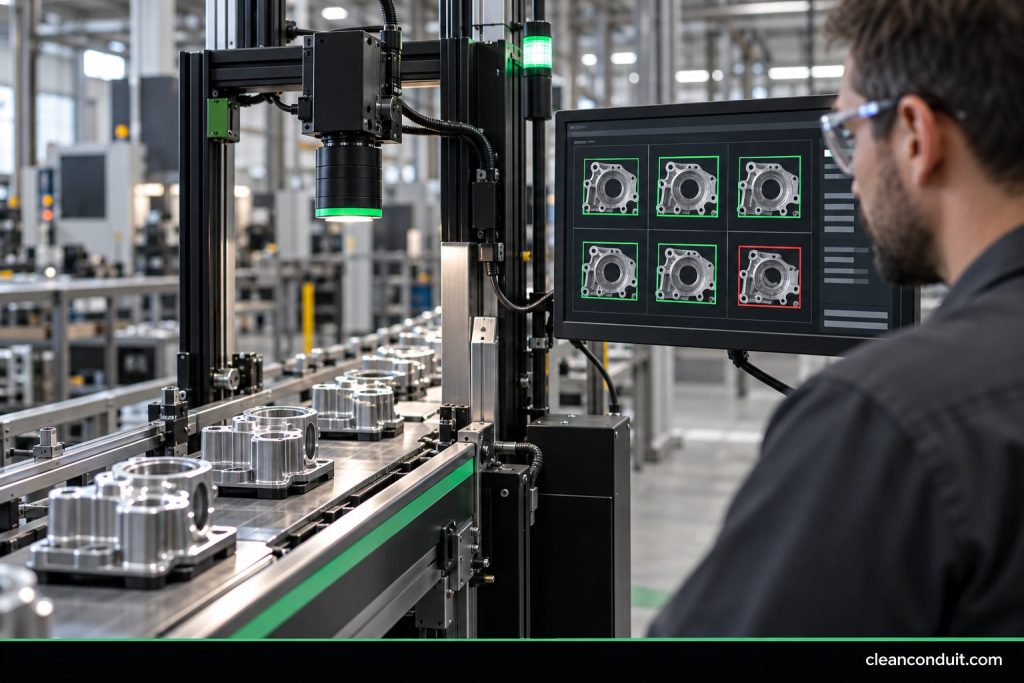
A supplier struggling with inspection bottlenecks could quantify its existing inspection labour, throughput and defect detection performance before proposing an AI-enabled vision system.
The application can then connect the investment directly to measurable outcomes.
Manufacturers should consider quantifying improvements such as increased units produced per hour, shorter cycle times, lower scrap rates, fewer production interruptions, increased annual capacity, reduced unit costs, faster product development cycles or new revenue opportunities.
A strong proposal also explains why the selected technology is the right solution. If a company is implementing advanced manufacturing hardware, for example, it should describe how that technology will fit into the existing production process, what changes will be required and which performance measures are expected to improve.
The same principle applies to lean manufacturing. Rather than simply stating that the company plans to adopt lean manufacturing techniques, the application should show which processes will change and how those changes will improve operational efficiency.
This helps position the project as a well-planned modernization investment rather than an equipment purchase.
How Clean Conduit Can Help With an O-AMP Application
Preparing an O-AMP application involves more than completing a form. The project needs to meet the program’s eligibility rules, the budget needs to distinguish eligible project costs from other expenses, and the proposal needs to explain why the investment will improve the business.
Clean Conduit can help manufacturers work through that process before an application is submitted.
Support can include reviewing the proposed project for O-AMP fit, helping identify eligible costs, organizing the project scope and timeline, and developing the business case around measurable improvements such as process efficiency, cost savings, production capacity, product development or job creation.
Clean Conduit can also help applicants gather and organize the supporting information needed for the submission, including vendor quotations, financial documentation, project details and key performance metrics.
Where a project involves advanced manufacturing hardware, production tracking systems, computer aided manufacturing, lean manufacturing or other process technology, the application can be structured to clearly connect those investments to the program objectives.
Another important part of the process is turning technical project details into a clear project proposal. A manufacturer may know exactly what equipment it needs, but the application still has to explain the current operational problem, the proposed solution, the implementation plan and the expected results. Clean Conduit can help organize that information into a more complete and consistent application.
Because O-AMP applications must ultimately be submitted by the applicant through Transfer Payment Ontario, Clean Conduit’s role is to help prepare the company for submission rather than submit the application on its behalf.
Starting this work before the next intake opens can be especially useful. It gives manufacturers time to confirm eligibility, obtain quotes, collect financial statements, define project metrics and resolve gaps before a deadline is approaching.
Is O-AMP Open in 2026?
The 2026 O-AMP Round 7 intake is closed. Applications were accepted between March 4 and April 16, 2026, and the Government of Ontario states that details of the next intake will be announced later.
That does not mean manufacturers should postpone planning.
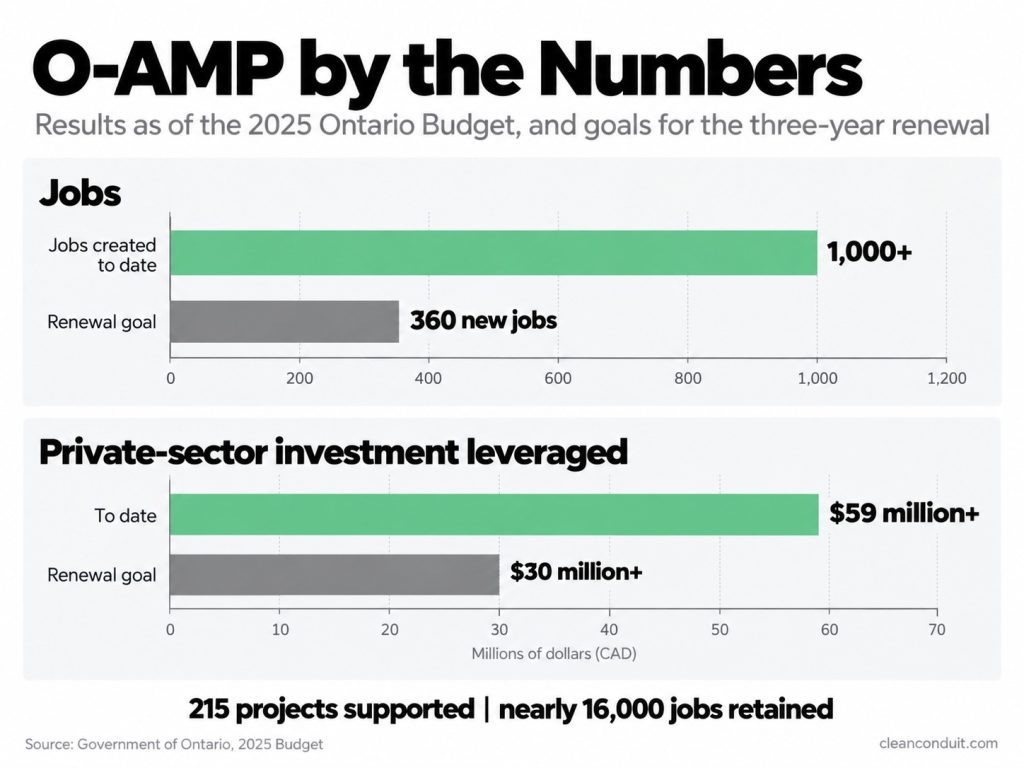
Ontario renewed O-AMP with $12 million over three years beginning in 2025-26, following a program that had already supported 215 projects, helped create more than 1,000 jobs, retained nearly 16,000 jobs and leveraged over $59 million in private-sector investment by the time of the 2025 Budget.
Companies considering automation, Industry 4.0 technology, AI-assisted manufacturing, new product development capabilities, advanced manufacturing hardware or lean improvements can use the period between intakes to develop a project that is ready when the next opportunity is announced.
Preparing for the Next O-AMP Intake
For Ontario automotive manufacturers, O-AMP can significantly reduce the cost of modernization, but the funding should be viewed as support for a defined productivity or competitiveness project rather than simply as a rebate on equipment.
The most useful preparation work can happen before the next intake opens. Manufacturers can identify an operational challenge, establish baseline performance, determine the appropriate technology or process change, obtain reliable quotations, secure the company’s share of financing and quantify the results the project is expected to produce.
Whether the project involves advanced manufacturing hardware and software, production tracking systems, enterprise resource planning, computer aided manufacturing, rapid prototyping, new process technology or lean manufacturing practices, the application should connect the investment to a specific business need and measurable results.
With Round 7 now closed and the next intake yet to be announced, manufacturers considering an O-AMP grant in Ontario have an opportunity to prepare a stronger, investment-ready project before the next application window opens.
Frequently Asked Questions About the O-AMP Grant
Eligible Ontario automotive suppliers can currently receive up to $150,000, covering a maximum of 50% of eligible project costs.
Potentially. Advanced manufacturing hardware and associated implementation costs can qualify when they form part of an eligible modernization project and meet the program requirements.
Yes. Production tracking systems, enterprise resource planning technology and other manufacturing software may fit within technology adoption for process efficiency when they are directly connected to an eligible project.
Yes. Computer aided design, computer aided manufacturing, finite element analysis and related tools may fit within projects intended to support new product development.
Rapid prototyping tools may qualify when they form part of an eligible product development or manufacturing modernization project.
Yes. Suppliers of technologies, components, software and products for electric vehicles and EV battery components can qualify, provided they meet the other eligibility requirements.
Round 7 explicitly welcomed proposals incorporating AI solutions and AI-related knowledge. Examples in the program guidelines include predictive analytics and computer vision. Applicants should confirm the priorities of the next intake once new guidelines are published.
No. Ontario’s current O-AMP guidelines exclude the aftermarket parts industry.
Yes. Eligible businesses participating in the supply chain for passenger and commercial vehicles may qualify if they meet the other program requirements.
Yes, but a previous O-AMP project must have been successfully completed by the applicable intake deadline before the company can apply for another project.