Canadian businesses and organizations affected by tariffs and global trade disruptions have a major federal funding opportunity through the Regional Tariff Response Initiative (RTRI).
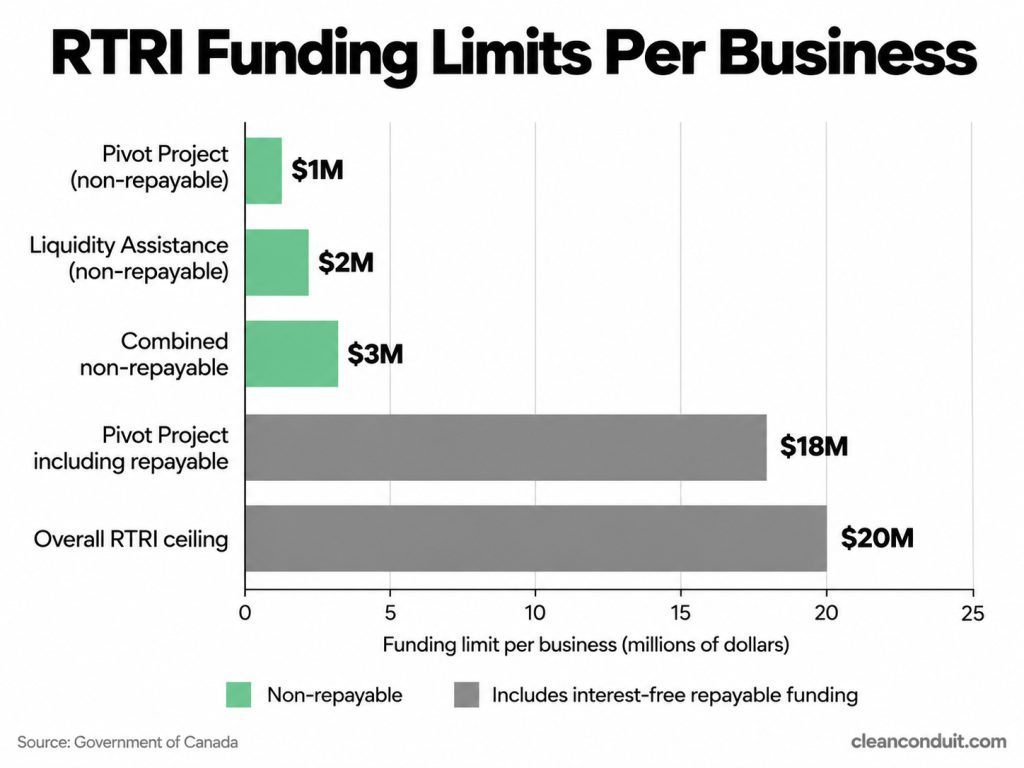
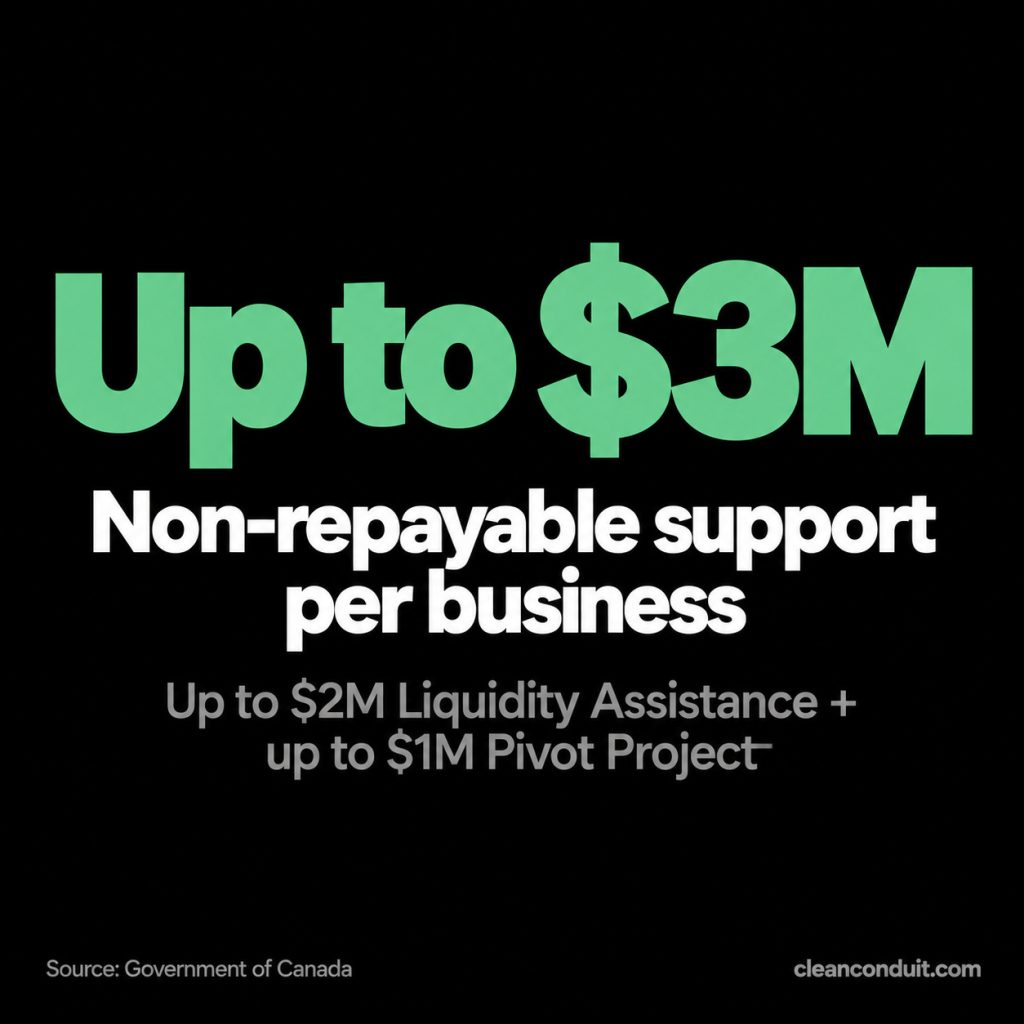
The expanded RTRI can provide eligible companies with up to $3 million in combined non-repayable support through two funding streams: Liquidity Assistance and Pivot Projects.
Liquidity Assistance addresses short-term tariff-related financial pressures, while Pivot Projects support longer-term investments in productivity, automation, digitization, market diversification and supply chain resilience.
The Government of Canada has committed $3.45 billion nationally to the RTRI, which is delivered through Canada’s regional development agencies.
The result is a program designed not only to help Canadian businesses manage immediate tariff impacts, but also to help them reduce costs, improve productivity, build more robust domestic supply chains and become less vulnerable to future trade disruptions.
RTRI funding option | Potential support | Primary purpose |
|---|---|---|
Liquidity Assistance | Up to $2 million non-repayable | Maintain Canadian operations and employment while managing short-term tariff pressures |
Pivot Project | Up to $1 million non-repayable | Modernization, productivity, technology, market diversification and resilience |
Combined non-repayable support | Up to $3 million | Liquidity Assistance plus a qualifying non-repayable Pivot Project |
Larger Pivot Project | Repayable funding may be available above $1 million, generally up to $18 million | Larger transformative investments |
The $3 million figure is a combined maximum, rather than a $3 million grant for a single modernization project.
A business seeking only non-repayable Pivot Project funding would normally be looking at up to $1 million, while a company that also demonstrates an eligible liquidity need could potentially access additional non-repayable support.
What Is the RTRI?
The RTRI is a federal economic support program created to help Canadian businesses and industries adapt to changing global trade conditions.
It forms part of the Government of Canada’s broader tariff response and focuses particularly on businesses that have been directly or indirectly affected by tariffs, countermeasures, supply chain disruptions or related market pressures.
RTRI is designed to protect Canadian economic capacity and employment while helping businesses build a stronger position for the future.
That means the program can support investments that increase productivity, lower costs, diversify markets and strengthen supply chain resilience.
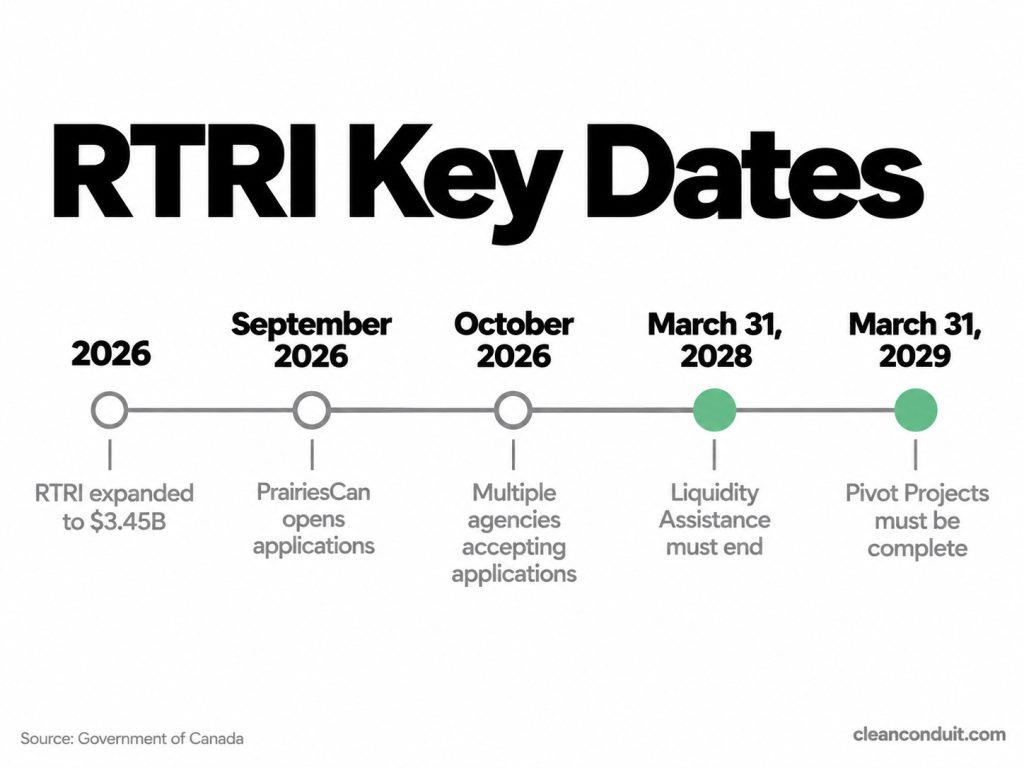
The federal government expanded RTRI in 2026, bringing the funding being delivered through Canada’s regional development agencies to $3.45 billion.
The initiative is particularly relevant to small and medium-sized enterprises that have viable Canadian operations but are being forced to reconsider their costs, production methods, suppliers or customers because of global trade disruptions.
A manufacturer might use RTRI to automate a production line.
Another company could invest in technology that allows it to bring production back into Canada.
A business that depends heavily on one export market could pursue new Canadian or international customers.
Another applicant might need temporary liquidity while it carries out a more permanent business transformation.
These are different challenges, but all can fit the broader goal of helping businesses adapt to tariff impacts and remain competitive.
RTRI Funding: How Does It Work?
The expanded RTRI provides two main forms of financial support to businesses.
The first is Liquidity Assistance.
The second is funding for Pivot Projects.
A business may apply for one type of support or both, depending on its financial position, tariff exposure and proposed response.
Liquidity Assistance: Up to $2 Million Non-Repayable
Liquidity Assistance is intended for businesses experiencing immediate financial pressure because of tariffs and related trade disruptions.
Eligible businesses may receive up to $2 million in non-repayable funding for a period of up to 12 months.
The calculation is primarily tied to 50% of eligible payroll, while certain essential recurring operating expenses may also be considered when necessary.
Those expenses can include rent or commercial lease payments, utilities, business insurance and property taxes.
Liquidity Assistance is not intended to reimburse the tariffs themselves.
Tariffs, customs duties, export taxes and similar government charges can help establish that a company has been negatively affected, but they are not themselves eligible liquidity costs.
The purpose is instead to help viable businesses maintain Canadian operations and employees while management responds to changing market conditions.
Liquidity Assistance must end no later than March 31, 2028.
Pivot Projects: Up to $1 Million Non-Repayable
Pivot Projects focus on longer-term adaptation and business modernization.
Rather than helping a business simply absorb short-term costs, a Pivot Project is designed to make structural adjustments that improve competitiveness and enable greater resiliency.
Eligible businesses can normally seek up to $1 million in non-repayable funding, covering up to 50% of eligible project costs, where the project creates broader local or regional economic benefits.
All Pivot Projects must be completed no later than March 31, 2029.
Repayable Funding for Larger Pivot Projects
Businesses pursuing larger-scale transformative Pivot Projects may also be eligible for repayable RTRI funding above $1 million.
Repayable contributions can cover up to 75% of eligible project costs, and RTRI support for Pivot Projects can reach up to $18 million per business when repayable funding is included.
These contributions are interest-free, with repayment terms established in the funding agreement, and are intended for larger commercial investments that improve productivity, competitiveness and resilience against future trade disruptions.
Repayable funding allows businesses to obtain up to $20 million in RTRI funding. The $20 million maximum includes any other RTRI assistance received by the business, including Liquidity Assistance, so it should be viewed as the overall program ceiling rather than an additional $20 million on top of other support.

What Projects Can Qualify?
The RTRI is broad enough to support a range of investments, but the project must address a real trade-related business challenge.
Across regional development agencies, common eligible Pivot Project activities include productivity improvements, process modernization, technology adoption, automation, digitization, market diversification, export development and investments in supply chain resilience.
That can make RTRI particularly relevant to manufacturing companies and other businesses investing in new production capabilities.
For example, a company affected by higher imported input costs could automate part of its production process to reduce unit costs.
A manufacturer could purchase equipment that allows work previously completed outside Canada to be brought in-house.
A business dependent on a small group of U.S. customers could invest in the systems, production capacity or market development required to reach new customers.
A company experiencing supply chain instability could develop a project focused on alternative sourcing, domestic production or improved supply chain reliability.
Business challenge | Potential RTRI Pivot Project |
|---|---|
Production costs are increasing | Automation, new equipment or process modernization |
Imported components are unreliable or expensive | Reshoring or new domestic production capabilities |
Too much revenue depends on one market | Market diversification and export development |
Manual processes constrain capacity | Digitization, automation or new technology |
Supply chain disruptions delay production | Supply chain diversification and resilience investments |
Existing equipment limits competitiveness | Machinery or technology adoption |
Compliance restricts access to new markets | Standards, certification or market-access activities where eligible |
Management lacks visibility into operations | Data systems, ERP or other productivity technology |
The key is not simply that a company wants new equipment.
The application needs to show why the investment is a response to tariff pressures or trade disruptions and how it will improve the company’s future position.
A strong project creates a clear connection between the problem and the investment.
In simple terms, a strong application should demonstrate this progression:
Tariff or trade disruption → measurable business impact → project investment → stronger competitiveness and resilience.
That connection is central to the business case.
Who Is Eligible for Funding?
Business-focused RTRI funding is primarily intended for tariff-affected small and medium-sized Canadian enterprises, although eligible non-profit organizations may also receive support under the initiative.
Non-profit organizations are not eligible for Liquidity Assistance for their own operating expenses.
Exact eligibility varies by regional development agency.
For business applicants, current guidance generally focuses on incorporated, for-profit companies operating in Canada that can demonstrate direct or indirect tariff impacts.
Across several regional agencies, business applicants are expected to have at least $1 million in annual revenue in one or both of their previous two fiscal years.
Businesses also need to demonstrate that they were viable before the tariff-related disruption. Most importantly, the applicant must show an actual tariff impact.
That does not necessarily mean the business must directly export products to the United States or personally pay a tariff. Indirect impacts can matter as well.
For example, a Canadian supplier may be affected because one of its major customers exports to a tariff-affected market.
A manufacturer could experience higher input costs because a supplier has passed tariffs through its pricing.
Another business could lose customers, experience supply chain disruption or face declining revenue because of changing trade conditions.
This means Canadian businesses should not automatically assume they are ineligible simply because the tariff does not appear directly on one of their own invoices.

Trade Disruptions: What Counts as Tariff Impact?
One of the most important parts of an RTRI application is proving the effect of trade disruptions on the business.
A general statement such as “tariffs are making business difficult” is unlikely to be enough. Applicants should quantify the impact wherever possible.
That could include increased material costs, changes in gross margin, lost sales, reduced purchase orders, delayed investments, disrupted suppliers, customer concentration, cancelled contracts or declining export revenue.
Documentation can strengthen the application.
Depending on the situation, useful evidence could include supplier notices, invoices, customs records, customer correspondence, purchase orders, financial statements and internal financial analysis.
The objective is to demonstrate that the tariff pressure is genuine and measurable. Then the business needs to explain how the proposed project addresses that pressure.
For example, consider a Canadian manufacturer that imports an important component and has seen its delivered cost rise substantially.
The company proposes purchasing new machinery that would allow the component to be manufactured internally.
Its application could quantify the current cost increase and then demonstrate how the investment would reduce unit costs, improve production reliability, increase Canadian content and protect existing employees.
That is considerably stronger than simply saying that new machinery would make the company more productive.
Eligible Project Costs Under RTRI
Eligible project costs vary according to the type of support requested and the regional development agency administering the application.
For Pivot Projects, costs generally need to be new, reasonable and directly related to the eligible project.
Eligible costs vary by regional development agency, but common Pivot Project expenses can include machinery and equipment, technology, incremental project labour, professional services, market development and supply chain improvements.
Other costs, including training and advisory services, may be eligible depending on the region and project. Applicants should confirm specific costs with their RDA before submitting an application.
Cost or investment | Potential RTRI fit |
|---|---|
Machinery and production equipment | Strong potential fit for eligible Pivot Projects |
Automation | Strong potential fit |
Digitization and technology | Strong potential fit |
Incremental project labour | May qualify |
Professional and technical services | May qualify |
Market development costs | May qualify |
Supply chain improvements | May qualify |
Business training and advisory costs | Region and project dependent |
Normal ongoing operating expenses | Generally not Pivot Project costs |
Tariff or customs payments | Not eligible as Liquidity Assistance costs |
Supply Chain Resilience and Market Diversification
Supply chain resilience is one of the central themes of the RTRI.
For many businesses, tariffs expose a concentration risk that already existed.
A company may rely too heavily on one supplier, one country, one customer or one export market.
RTRI can help companies make investments that reduce those dependencies.
That can involve strengthening domestic supply chains, bringing production into Canada, increasing Canadian materials and content or identifying new suppliers.
Supply chain diversification can also be paired with expansion into new domestic or international markets.
Market diversification projects can help businesses reduce their reliance on tariff-affected markets and reach new customers in Canada or abroad.
The initiative can therefore support the broader goal of creating more robust domestic supply chains while encouraging enhanced internal trade between Canadian provinces and territories.
For some companies, the best tariff response may not be an export project at all.
Selling more products within Canada can reduce exposure to global trade volatility while opening additional customers and markets.
For others, the strongest strategy may involve expanding into Europe, Asia or other global trade markets.
The right approach depends on the company’s existing customers, operations and competitive position.

RTRI Funding for Automation, Digitization and Productivity
One of the clearest opportunities under RTRI is business modernization.
Technology adoption, automation and digitization are specifically identified in regional program guidance as potential Pivot Project activities.
That makes the program relevant to manufacturers looking to increase production, reduce labour-intensive processes, improve consistency or introduce new technology.
It can also apply outside traditional manufacturing.
A company could potentially invest in systems that improve operational efficiency, inventory management, data collection or supply chain reliability where the investment forms part of an eligible tariff response.
The strongest projects will usually quantify the productivity gain.
If automation will increase output per hour, the application should estimate the improvement.
If new technology will reduce scrap, downtime or production costs, the business should quantify those savings.
If digitization will improve capacity or enable expansion into new markets, those outcomes should be measurable.
Funding agencies are not simply evaluating whether the technology is useful. They are evaluating what changes because of the investment.
Which Agency Do You Apply Through?
The RTRI is delivered through Canada’s seven regional development agencies rather than through a single national application portal.
The agency you approach depends on where your business or project is located.
Business location | Regional development agency |
|---|---|
British Columbia | Pacific Economic Development Canada — PacifiCan |
Alberta, Saskatchewan and Manitoba | Prairies Economic Development Canada — PrairiesCan |
Yukon, Northwest Territories and Nunavut | Canadian Northern Economic Development Agency — CanNor |
Northern Ontario | Federal Economic Development Agency for Northern Ontario — FedNor |
Southern Ontario | Federal Economic Development Agency for Southern Ontario — FedDev Ontario |
Quebec | Canada Economic Development for Quebec Regions — CED |
New Brunswick, Nova Scotia, Prince Edward Island and Newfoundland and Labrador | Atlantic Canada Opportunities Agency — ACOA |
This regional delivery model allows RTRI to maintain a common national framework while reflecting different economic conditions and priorities across Canada.
For example, southern Ontario businesses apply through FedDev Ontario, while businesses in Northern Ontario deal with FedNor.
Businesses in the Prairie provinces of Alberta, Saskatchewan and Manitoba apply through PrairiesCan.
British Columbia businesses work with PacifiCan, Quebec businesses with CED, Atlantic Canadian businesses with ACOA, and territorial businesses with CanNor.
Applicants should always review the guidance from their own agency rather than assuming that another region’s application rules apply to them.
Is the RTRI Accepting Applications?
The expanded RTRI is currently being delivered across Canada, and multiple regional agencies are accepting applications as of October 2026.
Current government pages explicitly identify open or active application processes in regions including British Columbia, Quebec and southern Ontario, while PrairiesCan announced the opening of applications for the expanded program across Alberta, Saskatchewan and Manitoba in September 2026.
Intake processes and timelines can vary by region.
Businesses should therefore contact or review their applicable regional development agency before preparing an application.
This is also important because funding is subject to assessment and availability.
Being eligible does not guarantee approval.
For companies already considering automation, new production equipment, market expansion or other strategic investments, it can make sense to investigate RTRI eligibility before committing significant project costs.
How to Build a Strong RTRI Application
A strong RTRI application should tell a simple and credible story.
It should establish a clear sequence: the business experienced a specific trade disruption, that disruption created a measurable impact, and the proposed investment addresses that impact while producing measurable business and economic outcomes.
Everything else in the application should support that story.
Start by documenting the tariff impact.
Explain which products, materials, suppliers, customers or markets are affected.
Quantify how costs, revenue, margins, production or employment have changed.
Next, explain the project.
Describe exactly what the company intends to purchase, install, develop or implement.
Then connect the investment back to the trade problem.
If the project involves automation, explain how automation will reduce costs or improve competitiveness.
If it involves supply chain diversification, identify the risk that is being reduced.
If the project involves new markets, explain how the investment will reduce customer concentration or reliance on tariff-affected markets.
Finally, provide measurable outcomes. The project should also be incremental. Federal agencies generally expect RTRI funding to produce measurable outcomes beyond the company’s existing activities rather than simply subsidize business as usual.
Application area | Examples of useful metrics |
|---|---|
Productivity | Output per hour, production capacity, cycle time |
Costs | Unit cost, material cost, labour cost, scrap reduction |
Markets | New customers, new markets, export revenue |
Supply chains | Canadian suppliers, reduced lead times, Canadian content |
Employment | Employees maintained or new jobs created |
Growth | Revenue, production or capacity growth |
Resilience | Reduced dependence on a supplier, customer or country |
What Documents Should Businesses Prepare?
The exact application requirements depend on the regional development agency, but businesses should expect to provide detailed financial and project information.
That can include recent financial statements, information about company ownership and operations, evidence of tariff impacts, a detailed project budget, financing sources, project milestones and expected outcomes.
Applicants seeking Liquidity Assistance should also expect to substantiate their liquidity need.
Current regional guidance can require payroll records, cash flow forecasts and evidence supporting eligible recurring operating costs.
Pivot Project applicants should be ready to demonstrate that they can finance their share of project costs.
Non-repayable Pivot Project support generally covers up to 50% of eligible project costs, meaning the business will normally need to finance the balance from other sources.
Businesses should also plan project cash flow carefully.
RTRI assistance is generally provided as a contribution, and approved costs may be reimbursed after they have been incurred and paid rather than being advanced to the company upfront.
PrairiesCan, for example, specifically states that successful projects normally receive periodic reimbursements after eligible expenditures have been incurred.
That distinction matters when financing equipment and other significant investments.
Sample RTRI Funding Scenario
Consider a Canadian manufacturer with $8 million in annual sales.
Historically, 40% of its revenue has come from customers in a tariff-affected export market.
Trade disruptions have reduced customer orders and placed pressure on margins.
At the same time, the company’s older production equipment makes it difficult to compete on price in other markets.
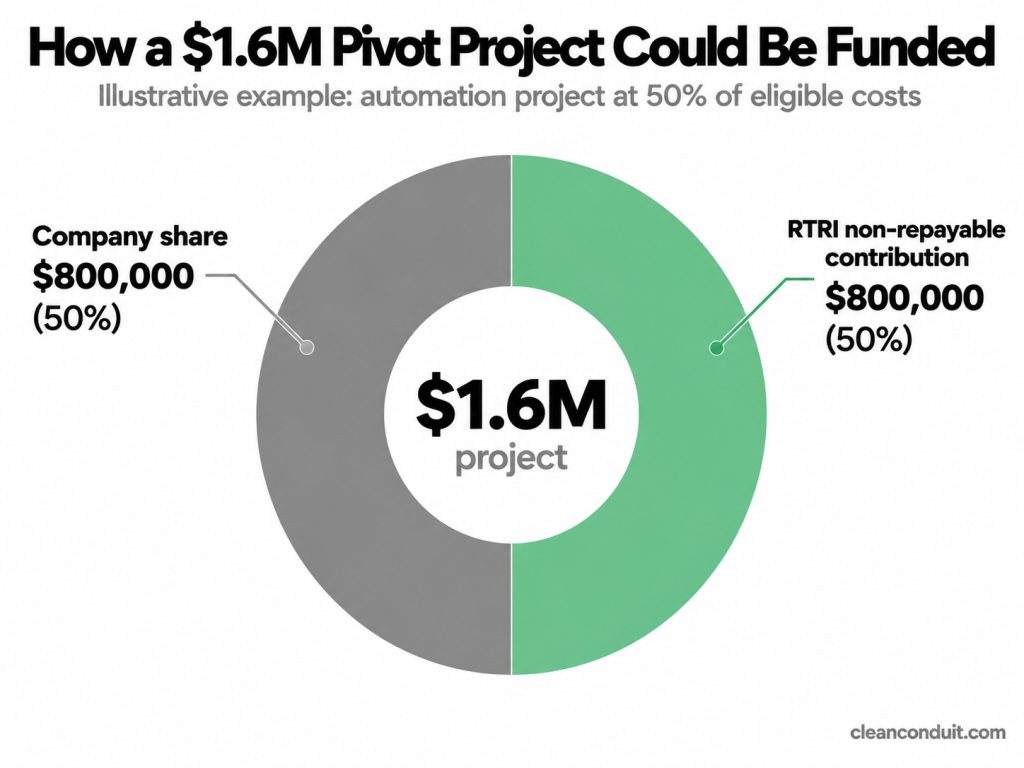
Management develops a $1.6 million project to automate a major production process, install new digital production controls and increase capacity.
The company estimates the project will reduce unit production costs by 15%, increase capacity by 25% and allow it to pursue customers elsewhere in Canada and internationally.
If the project qualifies for non-repayable Pivot Project support at 50% of eligible costs, the company could potentially request approximately $800,000.
If the company can also demonstrate a qualifying short-term liquidity requirement related to the tariff disruption, it may separately be able to pursue Liquidity Assistance.
The important point is that the funding request is supported by a clear business case.
The company’s tariffs are not merely background information.
They explain why the investment is necessary, while the automation project shows how the company will adapt.
Why RTRI Could Be Valuable for Canadian Businesses
One of RTRI’s distinguishing features is that it can address both immediate financial pressures and longer-term business transformation.
Liquidity Assistance can give businesses financial breathing room.
Pivot Projects can help those same companies invest in their future.
That combination can be particularly valuable when tariff pressures are forcing businesses to act sooner than they otherwise would.
Tariff pressures may accelerate investments in automation that companies had originally planned for several years from now.
A manufacturer that was reliant on one export market may suddenly need customers in three.
A company that relied on imported production may need to consider reshoring.
RTRI is designed to support those types of pivots.
For eligible companies, the program can turn a defensive response to tariffs into an opportunity to invest in productivity, innovation, market diversification and greater resilience.
Moving Forward With an RTRI Application
For tariff-affected companies, the strongest RTRI opportunity is often not simply short-term relief.
It is the opportunity to make investments that leave the business more productive, diversified and competitive after the immediate trade disruption has passed.
A strong application should demonstrate a measurable tariff impact, a well-defined project, realistic financing and a direct connection between the investment and greater business resilience.
Businesses should also confirm requirements with their regional development agency before they submit an application, since eligible costs, application processes and regional priorities can differ across Canada.
With up to $3 million in combined non-repayable support potentially available, companies facing tariff pressures should evaluate whether planned investments in automation, technology, production, market diversification or supply chain resilience could align with the RTRI.
How Clean Conduit Can Help With RTRI Funding
Clean Conduit helps Canadian businesses identify government funding opportunities, develop strong project proposals, prepare grant applications and manage funding requirements through project completion.
For companies considering RTRI, our team can assess how planned investments in automation, technology, productivity, market diversification or supply chain resilience may align with available funding.
We can also support the development of the project scope, budget, business case and measurable outcomes required for a competitive application.
Clean Conduit combines government funding experience with business, engineering and project management expertise, allowing us to support clients from early-stage project planning through application development and grant fulfilment.
Regional Tariff Response Initiative FAQ
An eligible business may receive up to $3 million in overall non-repayable funding, consisting of up to $2 million in Liquidity Assistance and up to $1 million for a Pivot Project.
No.
The maximum combines two different forms of support.
Liquidity Assistance addresses short-term financial pressures, while the non-repayable Pivot Project portion is generally capped at $1 million.
A Pivot Project is an investment designed to improve productivity, competitiveness and long-term resilience against trade disruptions.
Potential activities include modernization, automation, digitization, technology adoption, market diversification, export development and supply chain resilience.
A Pivot Project is an investment designed to improve productivity, competitiveness and long-term resilience against trade disruptions.
Potential activities include modernization, automation, digitization, technology adoption, market diversification, export development and supply chain resilience.
Liquidity Assistance can support certain operating costs associated with demonstrated short-term financial pressure.
Eligible costs can include employee salary and wages and certain essential recurring expenses such as rent, utilities, business insurance and property taxes.
No.
Tariffs and customs duties may demonstrate the financial effect of trade disruptions, but they are not eligible Liquidity Assistance costs.
Yes, qualifying Pivot Projects can include equipment and technology adoption, automation, digitization and other productivity improvements.
Yes.
Market diversification and export development are identified as eligible Pivot Project activities and can help businesses reduce dependence on tariff-affected customers or markets.
Potentially.
Projects that improve supply chain resilience, strengthen domestic supply chains or reduce trade-related risks are central to the program’s objectives.
No.
Businesses in tariff-impacted sectors across the economy may be eligible, provided they meet the applicable program criteria and can demonstrate tariff exposure.
Manufacturing companies may nevertheless be particularly well positioned because investments in equipment, production, automation, reshoring and supply chain resilience align closely with common Pivot Project activities.
Yes.
Support is also available for eligible non-profit organizations that help tariff-affected businesses adapt, improve competitiveness, expand trade opportunities and build resilience. Non-profit organizations are not eligible for Liquidity Assistance for their own operating expenses.
Specific requirements vary by regional agency.
Pivot Projects must be completed by March 31, 2029.
Liquidity Assistance operates on a shorter timeframe and must end no later than March 31, 2028.
Applications are submitted through the regional development agency responsible for the location of the business or project.
These agencies include PacifiCan, PrairiesCan, CanNor, FedNor, FedDev Ontario, CED and ACOA.